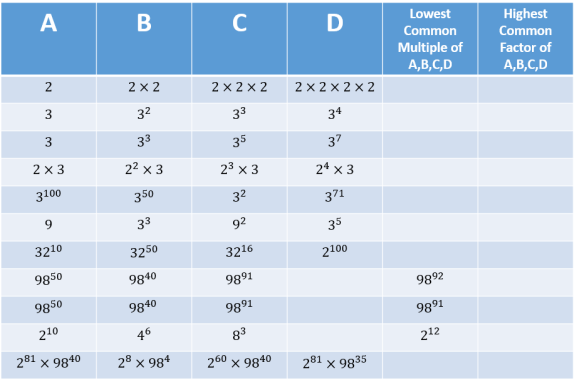
Been trying to use spare time at work to make some more worksheets and activities – Been on a Completion Table Hype Train recently so that is the bulk of what I am making at the moment – In general just trying to make any worksheet that I need has been a fun challenge over the past few weeks!
Equations to Ratios
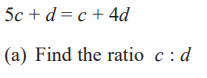
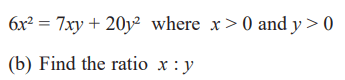
Our students were struggling with the two questions above – Both coming in their Mock from Edexcel Nov 2020 3H.
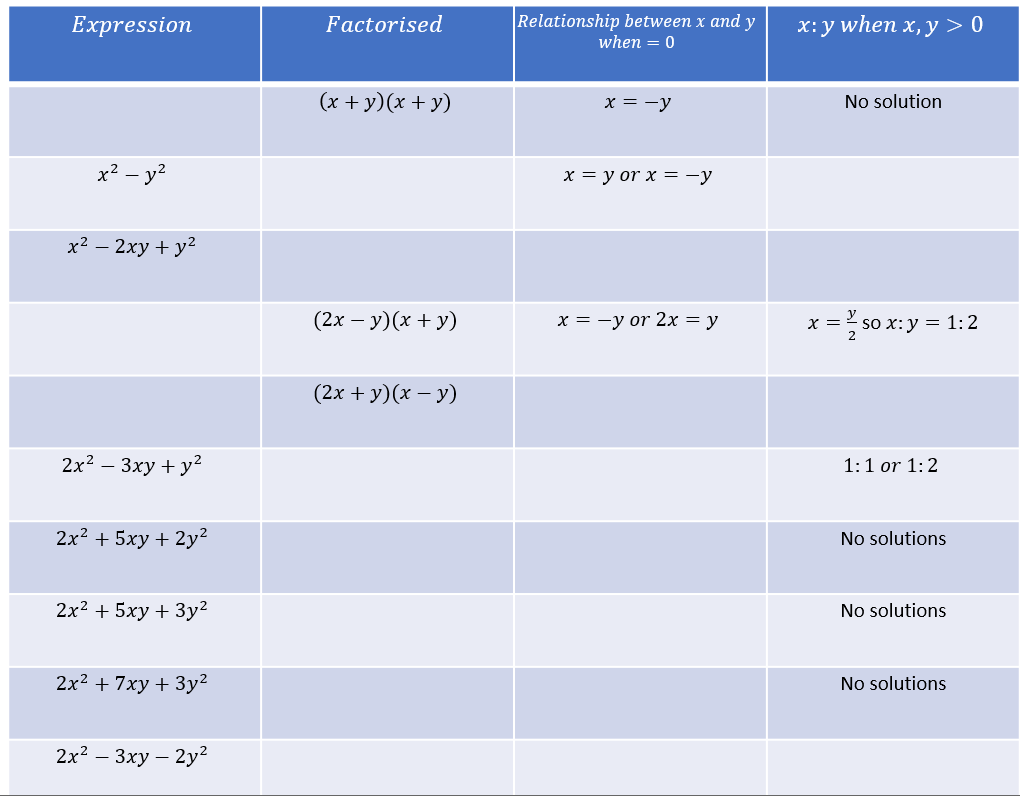
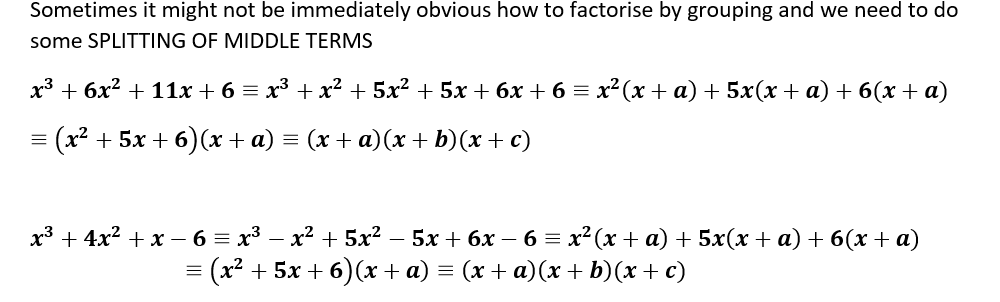
I decided to make a worksheet firstly just converting linear equations to ratios and then one where you had to factorise a trickier trinomial (Which I actually didn’t realise you could use splitting the middle term for so that was a nice surprise!)
Trying to find ways of scaffolding Compound Measures questions where you either have multiple journeys for Speed/Distance/Time or multiple objects for density calculation.
Been doing solving equations with a class and wanted some scaffolded practise of solving equations that contain brackets so made the two sheets below – One with unknowns on one side and one with unknowns (and brackets) on both sides
This question above caused some issues in a recent mock so tried to make an activity that could introduce the idea and give students a bit more practise – see below!
I recently came across this fencing problem posed by two mathematically minded farmers, the first part of which I feel is rather well known. Questions such as these are easy to visualise, meaning you can often give an instinctive answer and then test if your intuition was correct after solving the problem.
Part 1: The Warm Up
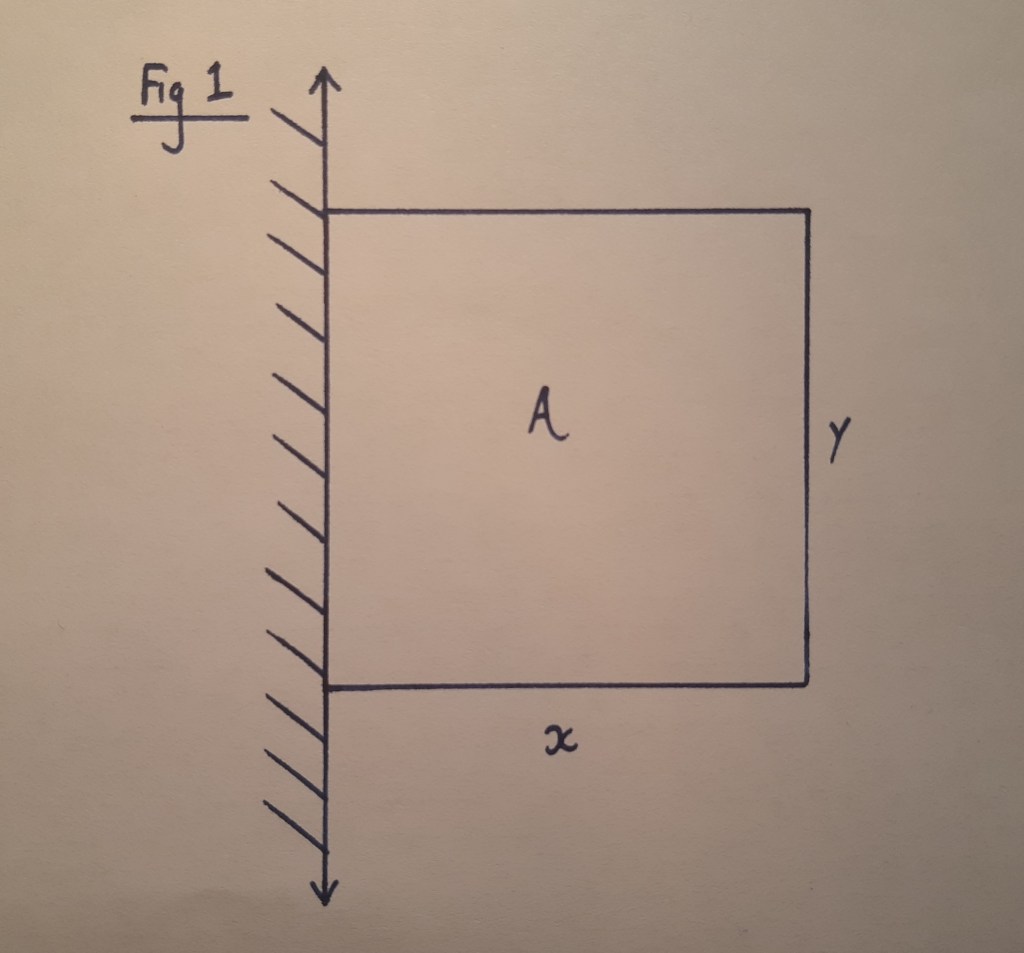
Consider an established farmer who has a very long (infinitely, if need be) straight fence forming part of the boundary of a field. Generously they have allowed you to use this fence, while constructing your neighbouring plot of land. Therefore we plan to enclose a rectangular field, only needing to build 3 sides of the quadrilateral. We will stipulate that the maximum length of these 3 sides is a length of L. The neighbours fence is shown below, on the left vertical.
Question: Using a fence of total length L, what ratio of sides will give the maximum area?
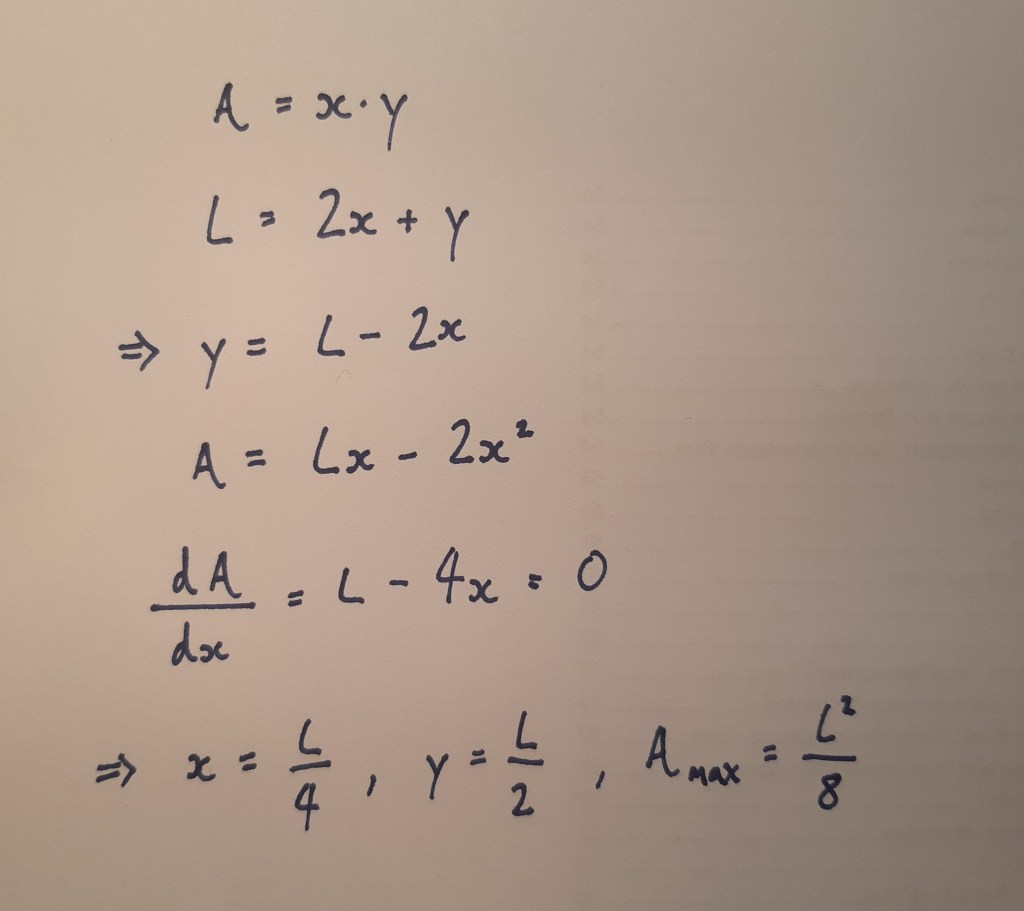
The idea here is to use the constraint on the fence length L to create an equation using our unknown side lengths, x and y. We can then use this to create a formula for the Area, using the constant L and one unknown.
With this formula in place, the problem then becomes a question of maximising the equation, which we can achieve by finding the stationary point of the derivative.
I’ve solved this below, so don’t scroll down if you would like to try this yourself!
The solution
I’ve also created a Desmos Graph to see how the area changes with different values of L.
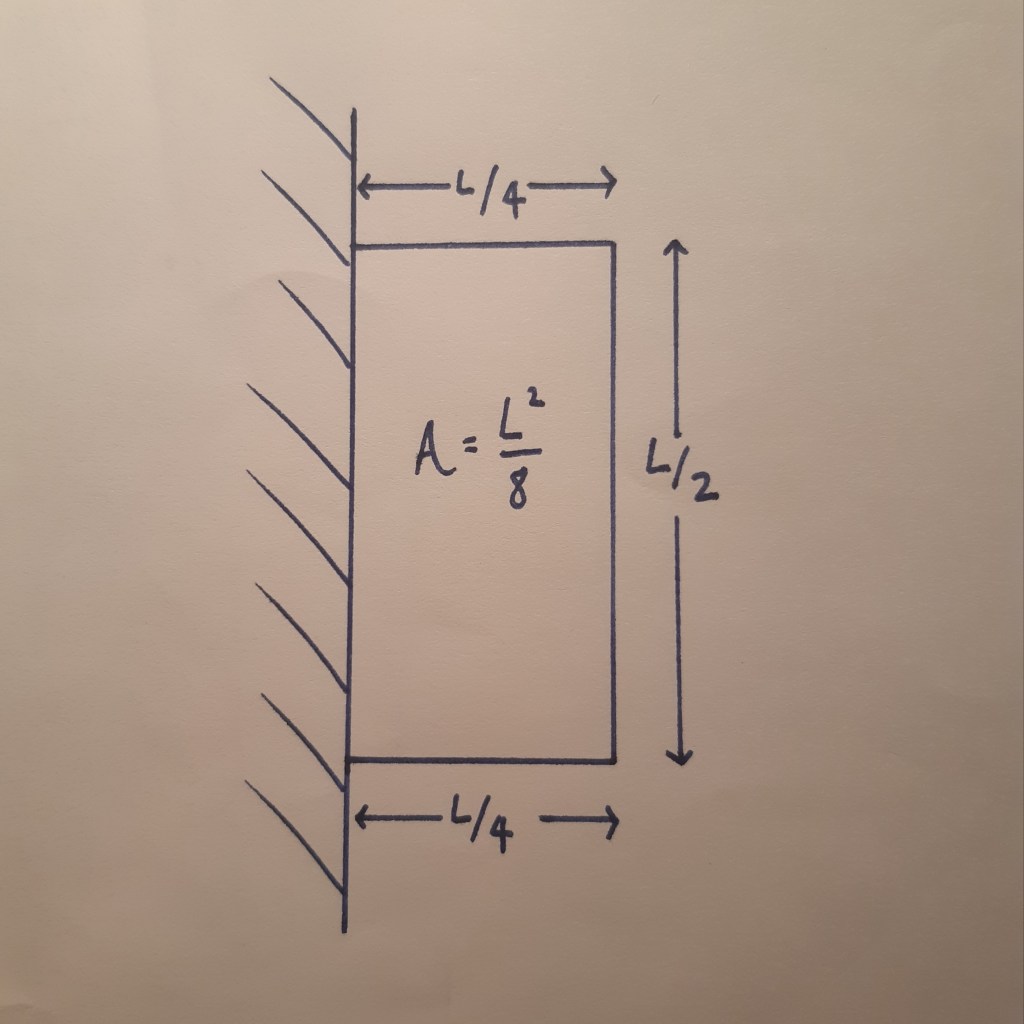
So the answer is a 2:1 ratio in the direction of the neighbours fence. While this may not have been your initial intuition, it follows that adding to the fence in the vertical direction only costs half as much as adding in the horizontal direction, due to the free fence offered by our neighbour. Therefore, the maximal area will be achieved by having a vertical length double that of the horizontal length.
The fences that solve the puzzle
We will leave how our generous neighbour tends to their field of infinite size to another day.
Part 2: The Main Event
Considering the success of the first project, we have decided to expand our farm by building a new fence for a new field. This time the plot of land is somewhat different.
In this case we have a square farm building in the middle of another very large field. We’ve realised that if we include the edge of the building as part of the fence, we can increase the area we enclose.
One option is to align the field with the edge of the farm building (shown on the left below). However, our established neighbour has suggested we might want to consider using the long diagonal of the building as part of the fence. These two scenarios are shown below for the vertical and diagonal configurations building.
Question: Again considering a total fence length L and a square building of length l in both scenarios, which configuration gives the maximum area?
Again the solution to these two configurations follows a very similar pattern to the warm up question above. However, instead of working out the ratio of the side lengths, we need to find the maximal area of each scenario.
In the interest of time, we will solve these in parallel as the solutions are very similar. Additionally, there is a neat trick that we can use to minimise the effort required. In opening two statements, we can observe that both equations have equal coefficients of x and y. Therefore, we can interchange x and y freely in the formulas (since they are variables we have made up to understand the problem). This means any solutions we find for x, is automatically valid for y and is called a symmetric argument.
Now all that remains is to determine which of the two areas in the final row are larger. If we assume that the vertical configuration yields a larger area than the diagonal configuration, we can create an inequality to simplify in terms of L and l.
So we have found that the relative lengths of the fence and the side of the building impact what choice we should make. If the fence is much shorter than the side of the building, then we should choose the vertical configuration. Of course, we can reverse the inequality to find the alternate scenario.
Again, I’ve created an interactive Desmos Graph that gives a visual interpretation of the problem.
With the two solutions in place, we can now compare against our original instincts to check if we were correct. If you were, well done! If, like me, you were not, I find it useful to examine to think about why my intuition failed in order to improve for next time!
And finally, as the old saying goes, the enemy of my enemy is my fence.
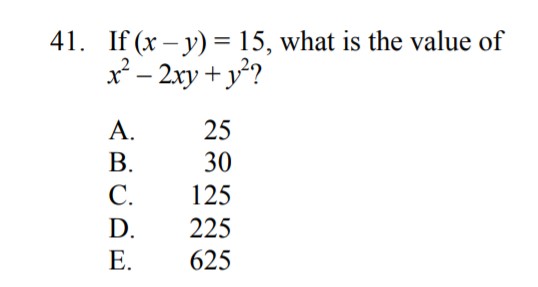
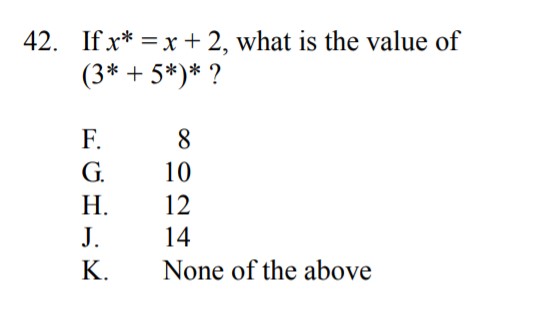
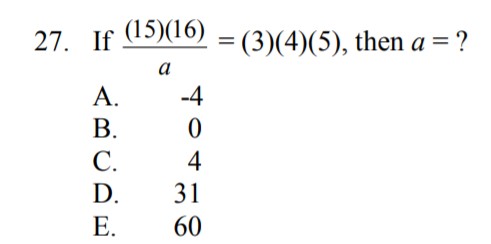
Two questions from the ACT (American College Testing)
The benefits of doing weird maths
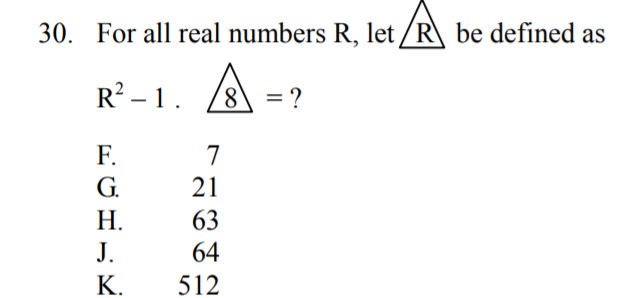
This is going to be a short post with some niche maths. Upon discovering that a good friend did the ACT exams instead of the GCSEs that I have done and taught I was immediately intrigued to see what the exam would look like. A bit of research led me to this document which is an absolute goldmine of maths. The questions above are two examples of questions from the ACT which you would just never see in the GCSE in england. They don’t require any new or radical Maths but are just phrased in such fun ways! I think giving students examples of what different Maths exams look like – Be that different exam boards or different continents exams – give students a chance to experience something weird that can set them up for the one inevitable weird question that might come up in their exams.
Another joyful ACT maths question
Doing maths makes you better at maths
I know that I am guilty of saying this in far too many of my classes but in general I really do believe that. In particular doing fun strange maths that gets you thinking and being playful with the maths you know will do wonders.
Here are a few more weird and fun versions of questions you might be used to seeing – Enjoy!
Like a simple factorial question or a complicated simplifying questionA triangle!
Post Credits
The attached document contains about 20 or so problems taken from the larger pdf linked above – Just a mix of some of the questions I particularly enjoyed.
Question taken from Brilliant.org – The most glorious of websites (Ans: a=4 b=3 can you show why)
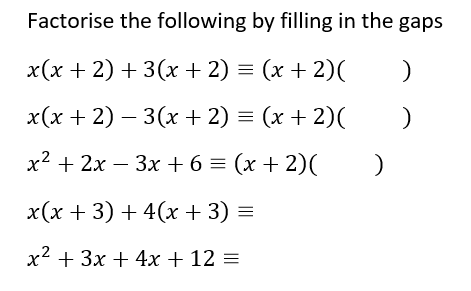
As with most of the Maths that I think about I got pretty obsessed with Factorising by Grouping after doing a question on Brilliant.org. (I will not spend too much time here talking about how much I love Brilliant.org but I absolutely absolutely love Brilliant.org and think that anyone that is interested in Maths and Problem Solving would love scrolling through its hallowed courses)
I was also in the process of discussing the factor theorem with my year 11 students and was repeatedly asked “Do I just use trial and error to find a factor”. As well as this technique works it doesn’t feel all that satisfying and certainly there is more fun maths to be found here if we look around.
The Fun Maths
The start of the Slow Build worksheet – start with something they have seen before
When putting together exercises to try and practise this skill I started with using factorising by grouping to factorise quadratics – something that the students were confident in and had seen before.
As the worksheet progressed the questions slowly increase in difficulty, with the scaffolding being taken away in steps.
Cubics joining the party
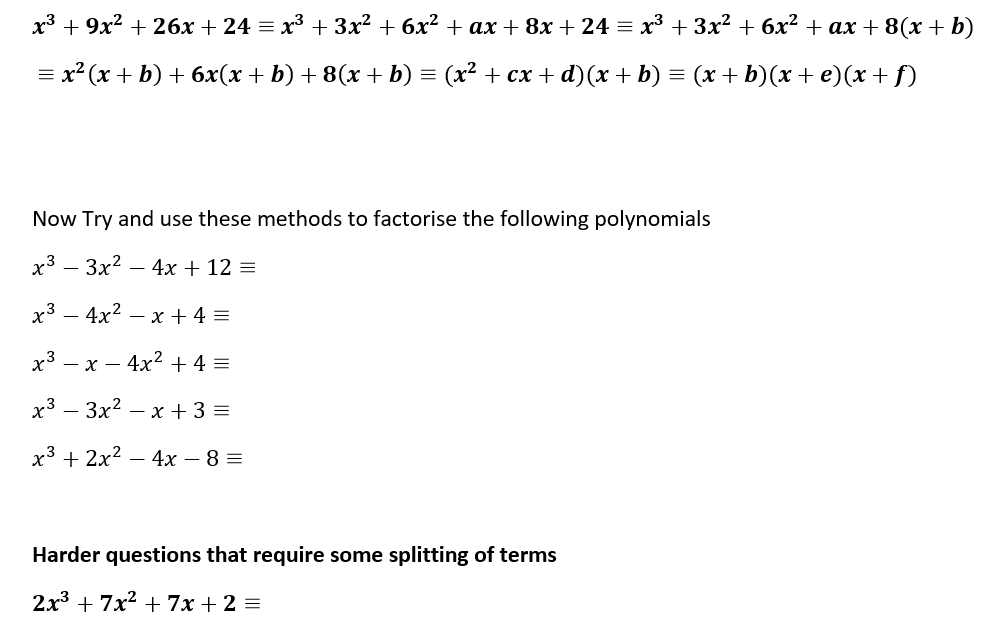
Eventually moving on to some all together more tricky cubics that require a splitting of the middle terms. This is a technique that is often used to factorise quadratics where the coefficient of the x squared term >1 but I had never seen it used to factor cubics.
Its these questions that I think were particularly fun to play around with as it is not immediately obvious how to split our terms nicely. I would encourage you to try to complete these questions as well as the rest of the questions on the sheet.
Try these questions yourself!
Post Credits
As we continued to try this out with different cubics it felt like we were once again using trial and improvement to work out how to split these trickier cubics up. It didn’t feel like a fruitless exercise as working out why your choices weren’t working and trying to choose better options feels like it has great benefit in become more fluent in your algebraic manipulation and also was just a fun way to practise lots of smaller expanding and factoring skills. It is always fun to practise these skills using deeper problems!
I spent a long time trying to come up with a clear method for factoring cubics by grouping when then grouping isn’t immediately obvious and I am still struggling! If you come up with anything please let me know at chelekmaths@gmail.com – I am excited to keep learning!
As it says in title – alternating and funk sequences
Firstly try the questions!
These series are a lovely in many reasons. Looking quite bonkers at first glance they can both be lovingly rearranged or broken apart to make them more accessible. All the series in this post can be split into two smaller more manageable series – for example in the first question by taking alternating terms you have a sequence which contains the sum of all odd numbers (1+3+5+7…) and an arithmetic sequence (-2-4-6…). Find the sum of 25 terms in each sequence, add them together and then the series is complete!
I used the worksheet with my year 13 class as a way of practising finding sums of arithmetic and geometric series but in a slightly more interesting context. Alternating sequences have also been known to come up on A level papers so its good to get exposure to them in lesson.
Additionally the extension of finding the sum of the first 51 terms adds in the challenge of working out what that 51st term would be (or just summing 26 instead of 25 terms in one of the series!) which is also some added fun.
You can click on the image of the worksheet below to download and then try it! (There are formulas for sums of geometric and arithmetic series that would definitely be helpful and can be found anywhere online)
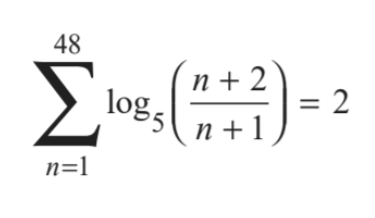
Also the last question using Logs is pretty tricky – There was a summation of logarithms question in the 2019 A level exam and it threw both my students and I! Actually a really lovely question that just feels scary if you hadn’t seen series with logs before.
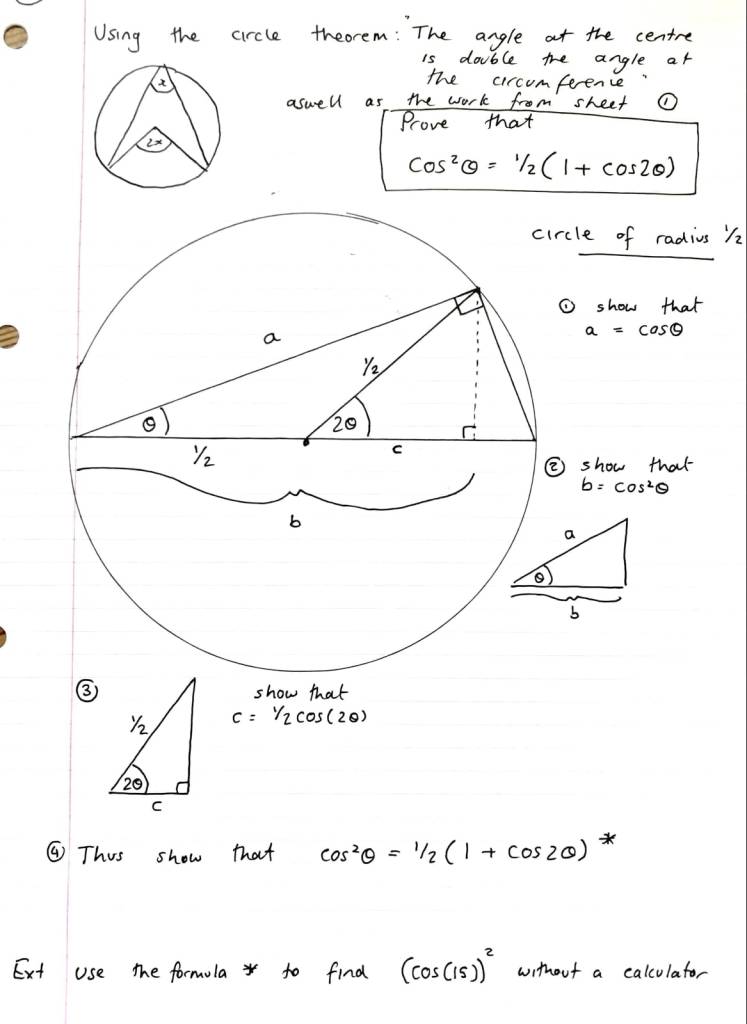
During this Lockdown period the wonderful youtuber 3blue1brown has created a youtube series called “Lockdown Maths” that have been a glorious set of lectures. These are two worksheets I created that directly use puzzles that are mentioned in this lecture: https://www.youtube.com/watch?v=QvuQH4_05LI&t=1501s
They are beautiful geometric proofs of some often (and less often) used Trigonometric Identities. The techniques used in the first sheet will help greatly in the second sheet and lead me to a fantastic aha moment.
For example in sheet 1 you end up proving pythagoras’ theorem from a trig identity – something that feels like the wrong way round!
images of worksheets (You can download them via the links below)














 Chelekmaths
You must be logged in to post a comment.