Categories
Learning from Puzzles Maths for Teaching

Quadratics on Quadratics

Stacks of Quadratics

Problem from the brilliant mindyourdecisions youtube channel

Firstly I would urge you to try the question in the photo yourself. It requires some knowledge of powers and solving quadratics and is wonderfully satisfying to find all SIX solutions.

Looking at easier examples

Questions like this are a great example of finding creative ways to practice fundamental skills. In this case one of the key skills being practised here is the ability to solve quadratic equations and rearranging them into a form that you can solve easily. So how to introduce this to a class?

A possible starting place

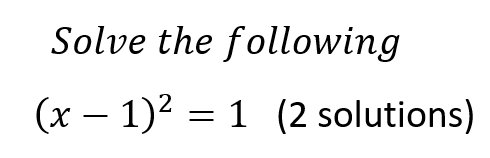
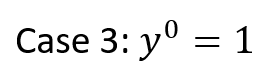
Lets look at the example in the picture – How can we can get to a solution of 1 on the LHS of our equation? The two cases that make this happen: Case 1 by setting (x-1) = 1 and case 2 by setting (x-1) = -1

Both these methods when squared will give us our answer of 1 and so that is where we will get our final values of x to be 2 and 0.

Taking it a step further

So taking it a step further we now an expression as our power which gives us a third case: Setting x+2 to zero. When the power is zero whatever is inside the bracket is irrelevant as any real numbers to the power of zero equal to 1.

Okay 1 to the power of anything is one so x-1 = 1 gives us our first solution: x=2

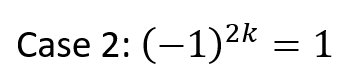
In case two we need -1 to an even power to get to one so we have x-1 = -1 which gives us a solution of x=0 which when put into the power gives us an even power so it must be a solution

Finally in case 3 we set x+2 = 0 which gives us our third solution and final solution which is x=-2 and it is solved! Now can we use this simpler example to work our way up to the six solutions of the first problem?

Creative Practice

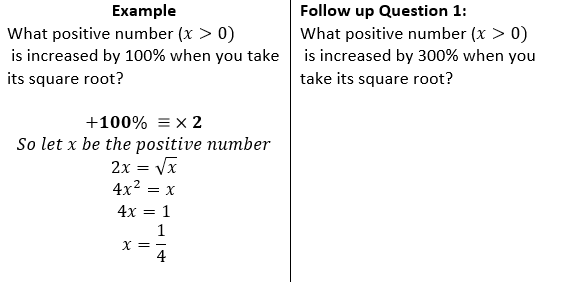
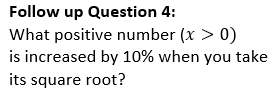
Small worksheet building up to answering stacked quadratic questions

I used the sheet above as a starter in my first lesson with my new year 11s – as a little bit of a fun way to gauge both their ability and their desire to apply maths they definitely know in ways they might not have seen before. The questions don’t lead onto each other as nicely as I might like but once we had discussed the first few the whole class were able to get their teeth into the rest of them.

By working through this small exercise they were able to practise factorising and solving quadratics in a way that felt fresh and interesting whilst also giving me an opportunity to circulate and learn more about my class.

Post Credits

I will not explain the full explanation for the question as it seems only fair to direct you to the original video here for a lovely detailed work through of the solution. Once you have watched the video try the rest of the worksheet!

I encourage you to try each of the questions looking at each of the three cases. Then try and come up with some of your own that fit this format – I always think one of the best ways to improve is to play around with writing your own questions and these are a fun way to start!

If you want to download the worksheet as a word document click here

Answers can be found on our Resources page

Thanks for reading!

NJK

Categories
Learning from Puzzles

Cracking the Cryptic: Joy and Magic Squares

A fun magic square problem that requires good knowledge of how they work – try it out!

Magic Squares

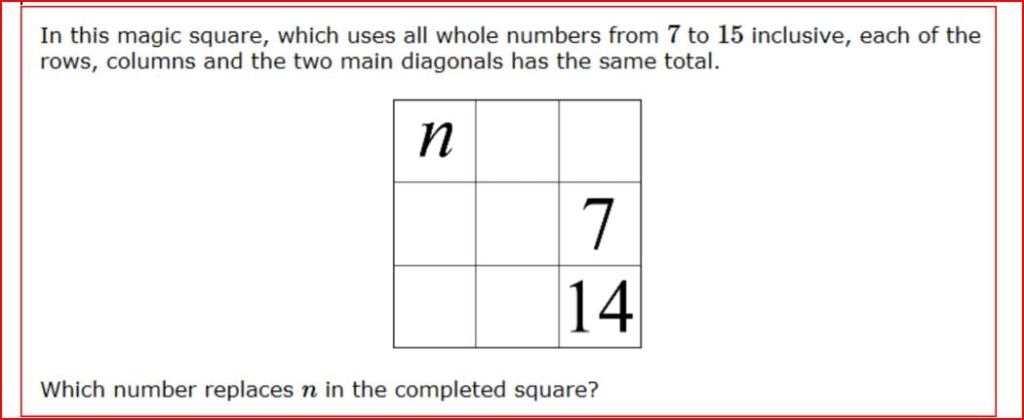
Magic squares always feel like a go-to end of term fun activity and one I have never given a particularly large amount of thought to – when I saw this question come up on a facebook maths page I am a member of I wasn’t sure how easy it would be but I talked it through in my head and came to a nice answer (I will go through the answer at the end of this post – Try it out yourself!) and I knew the reason I was able to solve this puzzle so easily was thanks to my new favourite YouTube channel: Cracking the Cryptic

Cracking the Cryptic

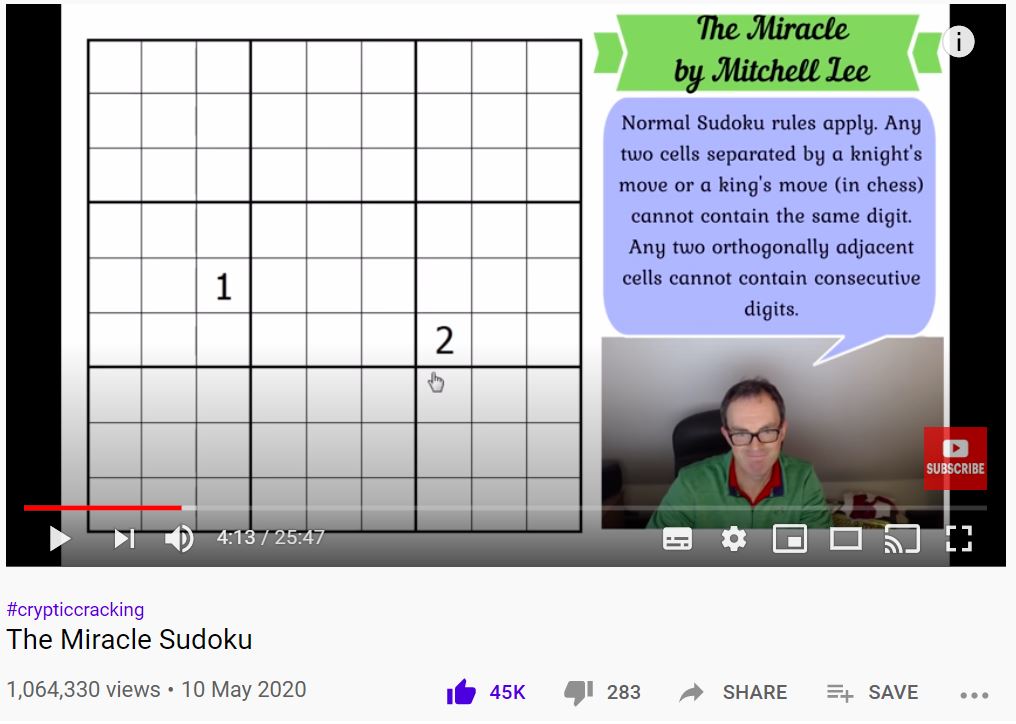
One of the glorious puzzles I have done during Lockdown

It’s hard to describe the pure joy that the YouTube channel crackingthecryptic has given me over the lockdown period. Glorious and regular puzzles that have honestly captivated me for hours on end. For a few weeks solving their latest puzzle over breakfast (and inevitably lunch because they were so tricky) became a minor addiction for me and lead me to many great Aha moments that my housemates soon tired of hearing about!

The above puzzle makes use of a simple 3 by 3 magic square in the middle of the grid that must contain all the digits 1-9 with all rows/columns/diagonals adding to the same amount. But how to even get started? As you know that all together the sum of the numbers 1-9 is 45 that means that each row/column/diagonal has to contain numbers that sum to 15 so that the three rows/columns add to the same amount and together add to 45. Then you can work out what number has to go in the middle an therefore is part of every single row/column/diagonal – the number ends up always being the median of the numbers you had to start with – so in this case it is 5 and that’s your starting point for the rest of the puzzle!

It was this previous knowledge that helped me to answer the question at the top of this post so quickly – because I had seen similar problems in different contexts I was able to use those problem solving skill to quickly find the number that should go in the middle square and then the rest of the problem solves itself from there. The more maths/puzzles you play around with the better you will be in the future!

Some of my favourite CtC puzzles

Below are screenshots and links to some of the bests puzzles I have attempted and sometimes even completed. I urge you to try them yourselves and let us know what you thought.

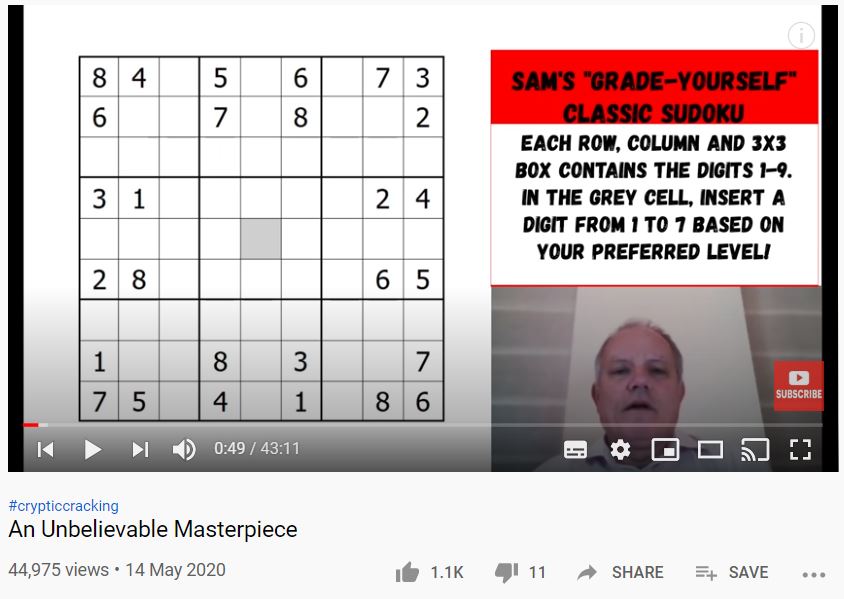
The most incredible puzzle solving hour of my life finishing this puzzle – click the picture to try it! It has OVER A MILLION VIEWS

Post Credits

The more puzzles and problems you grapple with the better you will be at grappling. Also it’s shocking how rarely I actually sit down and concentrate on something for an hour at a time without distractions and these Cracking the Cryptic puzzles gave me many of those hours.

How to solve: You know that as the whole grid must contain the numbers 7-15 the total of everything within the grid must be 99. As there are three rows/columns we divide by 3 to get 33 and therefore each r/c/d must equal 33 so the top left box must be 33-14-7=12

We also know that the number in the middle is the median number from 7-15 so must be 11 and then we fill in the rest of the grid from there! “n” must be 33-11-14 so n = 8

Let us know if you try and of the puzzles by clicking here – Thanks for reading!

NJK

Categories
Maths for Fun

ACTually very interesting

The benefits of doing weird maths

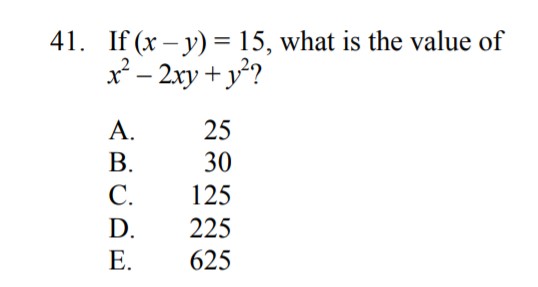
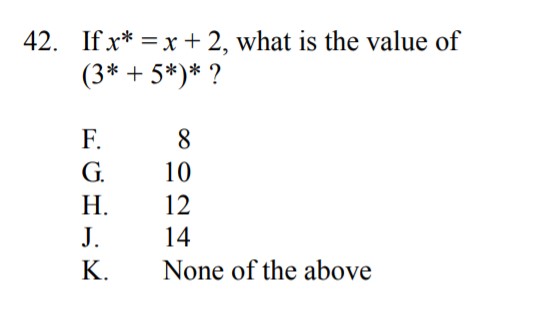
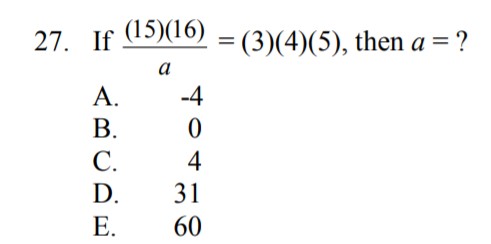
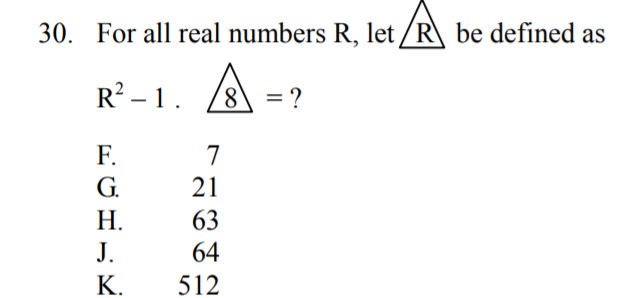
This is going to be a short post with some niche maths. Upon discovering that a good friend did the ACT exams instead of the GCSEs that I have done and taught I was immediately intrigued to see what the exam would look like. A bit of research led me to this document which is an absolute goldmine of maths. The questions above are two examples of questions from the ACT which you would just never see in the GCSE in england. They don’t require any new or radical Maths but are just phrased in such fun ways! I think giving students examples of what different Maths exams look like – Be that different exam boards or different continents exams – give students a chance to experience something weird that can set them up for the one inevitable weird question that might come up in their exams.

Another joyful ACT maths question

Doing maths makes you better at maths

I know that I am guilty of saying this in far too many of my classes but in general I really do believe that. In particular doing fun strange maths that gets you thinking and being playful with the maths you know will do wonders.

Here are a few more weird and fun versions of questions you might be used to seeing – Enjoy!

Like a simple factorial question or a complicated simplifying question
A triangle!

Post Credits

The attached document contains about 20 or so problems taken from the larger pdf linked above – Just a mix of some of the questions I particularly enjoyed.

Try them out! Let us know which ones you enjoyed here

Also the answers are found on the Resources page here

NJK

Categories
Learning from Puzzles

DOTS: One Trick to Solve Them All

The problems:

These three seemingly very different questions all showed up in the same SMC paper in 2017. Try each one yourself and see if you can work out what one trick links them all together!

DOTS: A Party Trick

A joyful example of the efficiency of DOTS

I’ve always been thrilled by the ability of using the “Difference of two squares” to simplify problems. Whether its answering numeracy problems quickly and easily like the one above or using it to crack open harder problems like the three SMC problems above.

Difference of two squares (DOTS) formula

At the bottom of this post I will include some worksheets (not made by me) that practice using this skill in simple and fun ways as well a lovely geometric proof of the above formula. There will also be some extension questions as well as seeing how these techniques show up in the A level curriculum.

The Answers:

Puzzle 1:
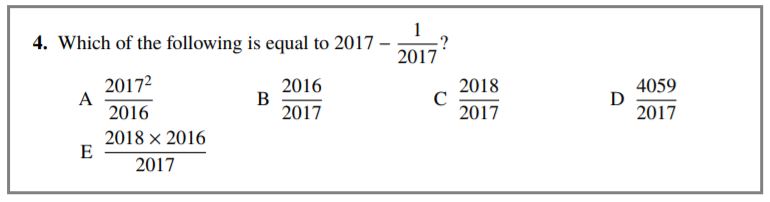
Question 4 from the 2017 SMC

This question is a great example of just starting off trying to simplify your answers and seeing what pops out. Looking at the multiple choice options available here its not immediately clear how any of those could possibly be the correct answers.

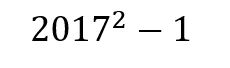
The most interesting part of working through this is when you get to the following step undefined Recognising that by definition 1 is a perfect square means that whenever you have a square number mius one you can use this formula. This give you the final piece of the puzzle which simplifies to answer E as shown below. Such a elegant question!
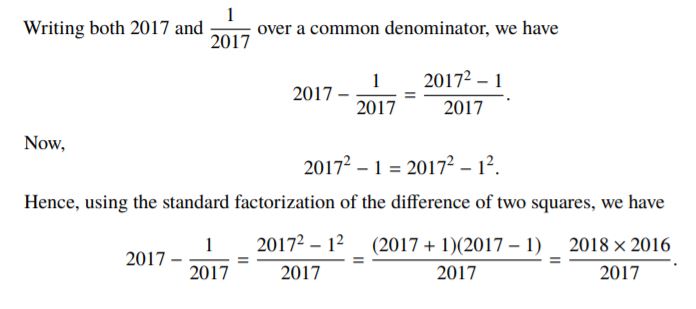
Solution to Q4
Puzzle 2
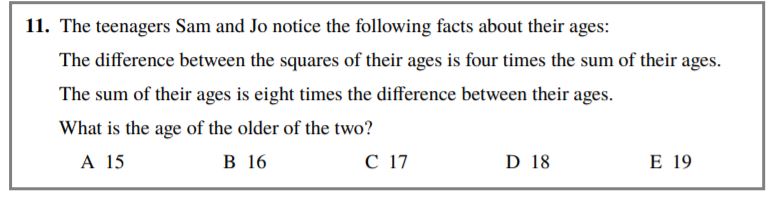
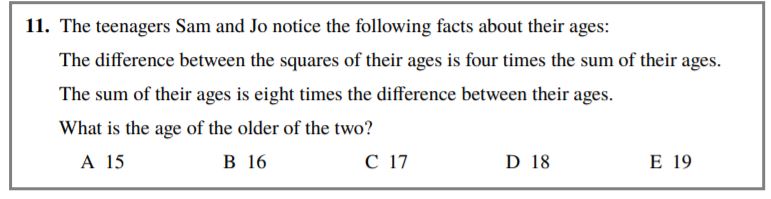
Qu 11 from SMC 2017

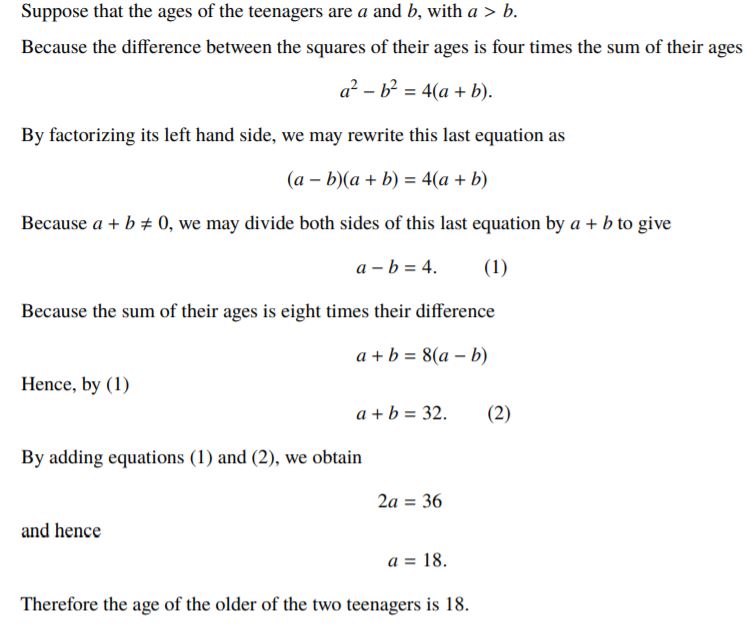
This one has a longer but no lesson elegant solution. There are plenty of ways to solve this one but the words “The difference between the squares of their ages” should immediately get the DOTS alarm bells ringing. Using DOTS simplifies this problem down in a lovely way and makes the algebra much more manageable as the answer below shows.

Answers for Qu. 11 SMC 2017

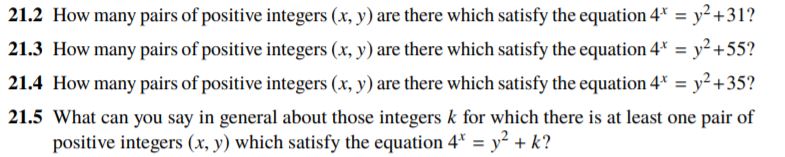
There is also some extension to this question which are a great way to practise the skills yourself – try them yourself and contact us if you have questions/answers!

Qu 11 Extensions
Puzzle 3: The finale
Qu 21. from SMC 2017

It is not immediately clear how DOTS could help you with this question. The first thing to say is that the main reason I thought to use this trick is simply that I have answered lots of problems before. There is no substitute for practise and increasing your mathematical toolkit but playing around with lots of different maths. Needing almost any excuse to use DOTS and additionally y squared in the question meant that I went down that route first of all.

I’m not going to go over every step of the question but the step where you set each bracket to different factor pairs of 15 is not an easy step to see – once again there is no replacement for practise and seeing this question will help with similar questions in the future – I will also include an A Level question that uses this exact technique later on.

Answer to Q21 SMC 2017

Honestly an absolutely glorious question. It is no surprise that it is one of the last questions in the Senior Maths Challenge (For school years 10+) when it requires lots of quite difficult techniques (also under a timed exam pressure! Very tricky!)

Extension questions for Question 21 – 21.5 is particularly juicy!
Bonus A level question:
This is a classic type of A Level proof by contradiction question that uses the same techniques as the question above

This A level question is a lovely way of seeing how theses skill show up in the school curriculum and are a great way to prove some seemingly not straightforward mathematical statements. Try it yourself! I have attached a link below to a document with a group of these questions and importantly the answers to them.

Post Credits

Difference of two squares is a wonderful trick that has a multitude of problem solving uses. The more problems you do and the more you can recognise this the easier (and more fun!) these questions will become.

I have included below a link to worksheets created by the legend Don Steward that can help you practise DOTS in numerical settings.

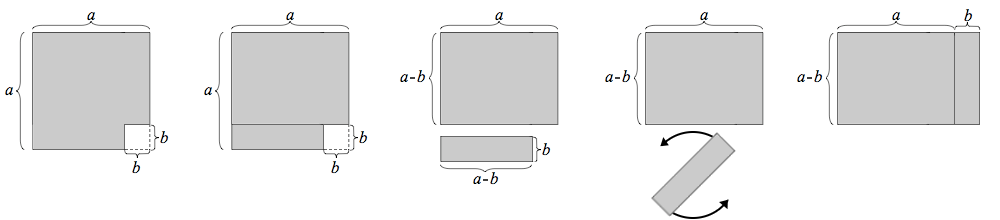
Lovely visual proof of Difference of Two Squares formula
Try doing these in your head! You’ll be surprised how easy they become (Click the link to download)

If you have any extra thoughts/questions please do send us a message and we will get back to you as soon as we can!
Contact us here!

NJK

Categories
Maths for Teaching slow build

Factor(is)ing

Spot the difference! Which wording are you used to and why?

Asking “What is Factorising?”

The majority of the time, when I hear this question asked in class I have heard the word “Brackets” come up in the response. As a teacher when I hear this answer I generally take it as correct – The student has clearly remembered part of the method behind factorising and is stating a key symbol they use during that process. But there would usually be silence when I asked how factorising related to its root – Factors. What are the factors of 3x+3 – why does it feel strange to describe (x+1) as a factor?

Using a Factor Tree to Practise Factorising

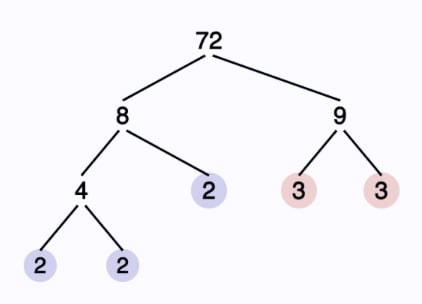
When students are taught to write numbers as the product of their prime factors we tend to use a “tree” to split the numbers (As shown below)

Example of Prime Factor Tree with Prime Numbers circled

I decided to see if I could use this same method to practise students ability to factor expressions as well and then create a link between what you are doing in both case – Splitting something into a product of their factors.

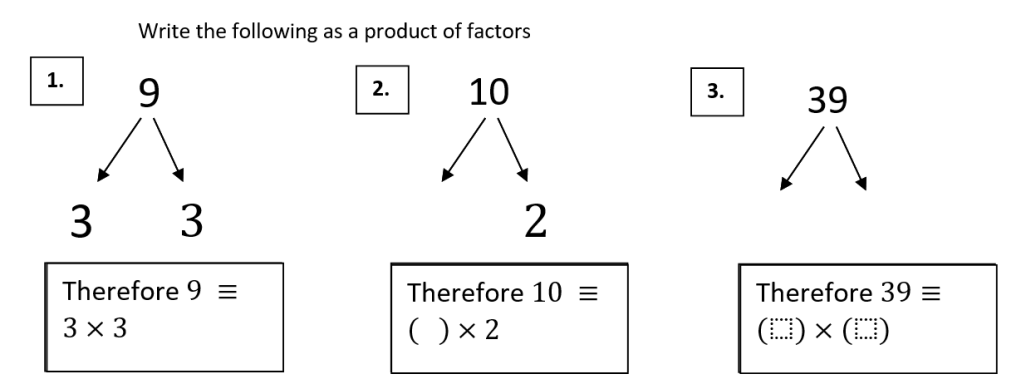
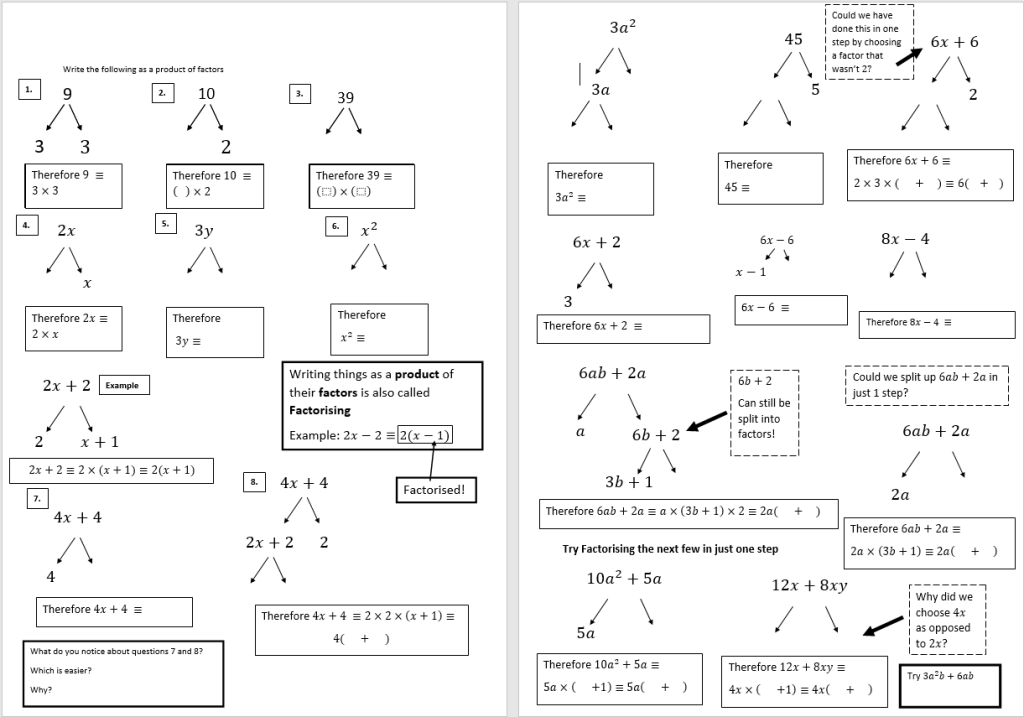
So I made a worksheet and gave it to my students to see what they would make of it. As the sheet contains a lot of structure I let them initially work through it in pairs and without giving them too much introduction so that they could do all the thinking themselves. Before this lesson we had previously practised how to factorise different simple linear expressions (Using the worksheet here) so we had already seen and discussed some of the maths behind expanding and factorising expressions.

The Worksheet

(The worksheet is attached here – I encourage you to try it yourself before continuing!)

The purpose of the worksheet is for students to recognise that when they are factorising the parts they have inside and outside the bracket are the factors of the expression. Intuition that will help with many similar problems later in their mathematical careers.

Worksheet starts with an example and builds from there – fill in the blanks!

The sheet uses the idea of a “Slow Build” to get students to start from something they are comfortable with and slowly build to deeper questions

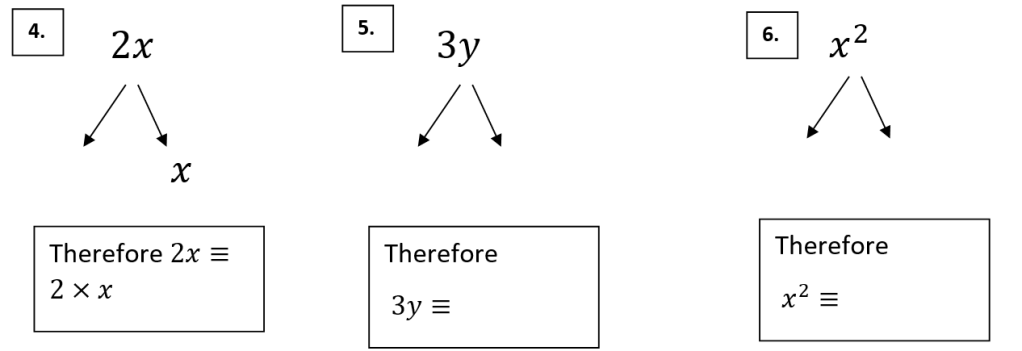
Moving onto using the same method for splitting expressions into factors

After quickly discussing questions 4 – 6 with the class they were then left to attempt the rest of the worksheet while I circulated to check on progress. The sheet contains various questions and hints that students are required to write an answer for which lead to some fantastic discussion throughout.

Example of hints and questions for encouraging deeper thought. In particular looking at the different ways you can start to split equivalent expressions.

The rest of the worksheet contains more practise including looking at harder examples eventually moving to expressions with multiple variables that they hadn’t seen before (Although in the context of this worksheet were answered quite successfully!)

Is x+3 a prime factor? Does it matter?

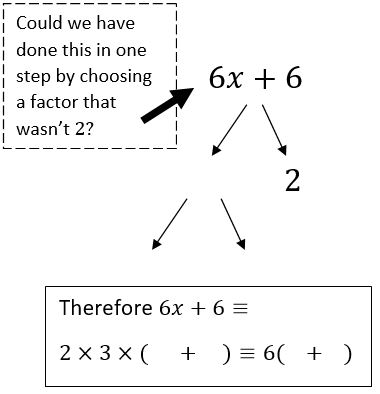
This Question on the left gets the students to ask if there is a more efficient way of answer the same question leading to a factor of 6 on the outside of the bracket later on. As a class we discussed the differences between prime factorisation and splitting things into their factors and also using brackets when writing something in its factorised form. This question on the left encapsulates lots of these thoughts at once.

Factor(is)ing

I am undecided as whether I like using the word Factorising when looking at products of factors or whether I prefer the more american Factoring. The (is) in Factorising feel slightly unnecessary and Factoring seems to convey just as simply that we are going to be looking into factors. Let me know which one you use!

Post Credits

Overall this worksheet created some very interesting discussion with my students and also led to increased fluency when dealing with factoring questions in later lessons. The idea that factors can also be algebraic expressions and not just integers was also a great source of conversation in the classroom during the lesson.

I have included an image of the whole worksheet below in case you are unable to view the download. Answers are available through the Resources page.

The whole worksheet – click it to download

Thanks for reading!

NJK

Categories
Maths for Fun Maths for Teaching slow build

Factorising by Grouping SB

The Problem

Question taken from Brilliant.org – The most glorious of websites (Ans: a=4 b=3 can you show why)

As with most of the Maths that I think about I got pretty obsessed with Factorising by Grouping after doing a question on Brilliant.org. (I will not spend too much time here talking about how much I love Brilliant.org but I absolutely absolutely love Brilliant.org and think that anyone that is interested in Maths and Problem Solving would love scrolling through its hallowed courses)

I was also in the process of discussing the factor theorem with my year 11 students and was repeatedly asked “Do I just use trial and error to find a factor”. As well as this technique works it doesn’t feel all that satisfying and certainly there is more fun maths to be found here if we look around.

The Fun Maths

The start of the Slow Build worksheet – start with something they have seen before

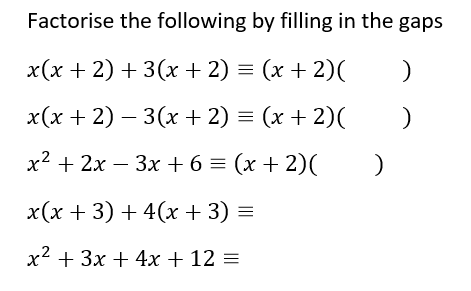
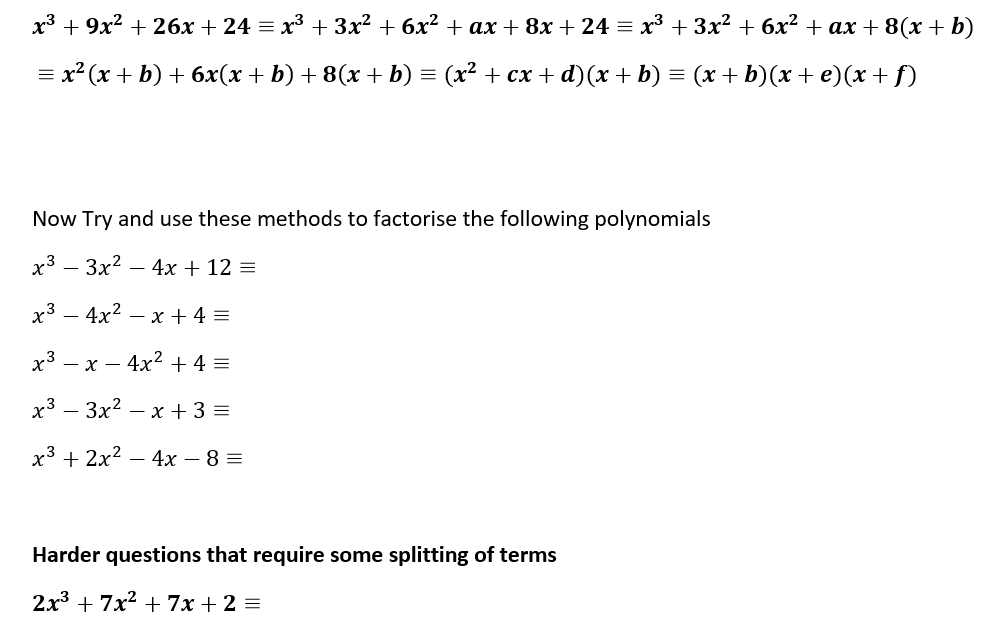
When putting together exercises to try and practise this skill I started with using factorising by grouping to factorise quadratics – something that the students were confident in and had seen before.

As the worksheet progressed the questions slowly increase in difficulty, with the scaffolding being taken away in steps.

Cubics joining the party

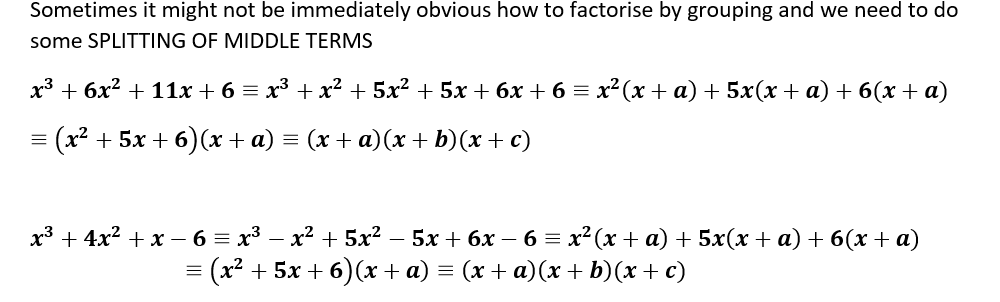
Eventually moving on to some all together more tricky cubics that require a splitting of the middle terms. This is a technique that is often used to factorise quadratics where the coefficient of the x squared term >1 but I had never seen it used to factor cubics.

Its these questions that I think were particularly fun to play around with as it is not immediately obvious how to split our terms nicely. I would encourage you to try to complete these questions as well as the rest of the questions on the sheet.

Try these questions yourself!

Post Credits

As we continued to try this out with different cubics it felt like we were once again using trial and improvement to work out how to split these trickier cubics up. It didn’t feel like a fruitless exercise as working out why your choices weren’t working and trying to choose better options feels like it has great benefit in become more fluent in your algebraic manipulation and also was just a fun way to practise lots of smaller expanding and factoring skills. It is always fun to practise these skills using deeper problems!

I spent a long time trying to come up with a clear method for factoring cubics by grouping when then grouping isn’t immediately obvious and I am still struggling! If you come up with anything please let me know at chelekmaths@gmail.com – I am excited to keep learning!

This is a link to the worksheet – click to download. You can also find it in the Slow Build section of the website as well as on our resources page.

NJK

Categories
Maths for Fun Maths for Teaching

Funky Alternating Sequences

As it says in title – alternating and funk sequences

Firstly try the questions!

These series are a lovely in many reasons. Looking quite bonkers at first glance they can both be lovingly rearranged or broken apart to make them more accessible. All the series in this post can be split into two smaller more manageable series – for example in the first question by taking alternating terms you have a sequence which contains the sum of all odd numbers (1+3+5+7…) and an arithmetic sequence (-2-4-6…). Find the sum of 25 terms in each sequence, add them together and then the series is complete!

I used the worksheet with my year 13 class as a way of practising finding sums of arithmetic and geometric series but in a slightly more interesting context. Alternating sequences have also been known to come up on A level papers so its good to get exposure to them in lesson.

Additionally the extension of finding the sum of the first 51 terms adds in the challenge of working out what that 51st term would be (or just summing 26 instead of 25 terms in one of the series!) which is also some added fun.

You can click on the image of the worksheet below to download and then try it! (There are formulas for sums of geometric and arithmetic series that would definitely be helpful and can be found anywhere online)

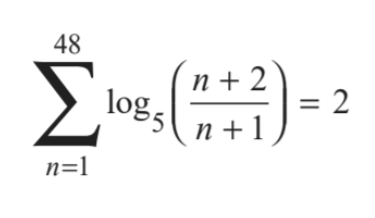
Also the last question using Logs is pretty tricky – There was a summation of logarithms question in the 2019 A level exam and it threw both my students and I! Actually a really lovely question that just feels scary if you hadn’t seen series with logs before.

Show that the LHS = RHS
Beautiful visual proof that the sum of n odd numbers is just n squared. (Image comes from youtube channel EpicIQ https://www.youtube.com/watch?v=MM7fb1HaRYQ)

NJK

Categories
Maths for Teaching slow build

Vector and Equating Shenanigans

undefined

Part 1: The Question

This rather innocuous looking question came at the end of one of our GCSE mock exams and at first glance didn’t seem like it would cause to many problems. Part a is simple enough but part b was basically unlike any question I had seen at GCSE – definitely not a question I had adequately prepared my students for. The marksheme doesn’t even reveal the true glory of this question

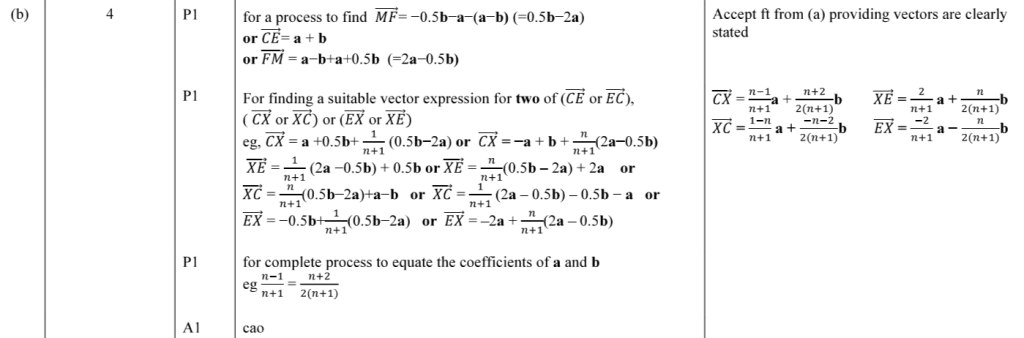
Markscheme for part b – the P1 for complete process to equate coefficients is the most brutal 1 mark I have ever seen

Every attempt to explain this question to students led to whiteboards full of confusion. So with the help of some wonderful colleagues we created some resources to help actually teach the skills required to achieve these few marks.

Part 2: Equating Coefficients

Start of the equating worksheet given to students (Can be downloaded from link at bottom of page)

We couldn’t find any resources for teaching equating so we decided to create one ourselves. We created a worksheet using the principles of the “Slow Build” where students slowly work through examples starting from examples they have seen before and getting progressively more difficult. Also always a shout out to Craig Barton and VariationTheory who I have big time fan girled over ever since I sat next to him in a session at BCME 2018. It felt fun to use the idea of collecting like terms – something that the students were very comfortable with – to explore a much deeper method.

Students have slowly built up to these more difficult questions where they need to use simultaneous equations to solve them. The second question in the photo is actually the exact equating problem they would have needed to solve in the earlier Vector Question

Working in pairs the students were able to carefully work through all the questions with minimal input from me – drawing a few students to our glorious whiteboards when they were in need of a nudge.

Example of using equating to factorize quadratics

The use of examples they recognized helped with the transition to more tricky and interesting questions on cubics later on an fed in nicely to our work with cubics (details in a future blog post)

Once I felt confident that the students were comfortable with the ideas behind equating coefficients we moved on to the main event (in a different lesson)

Part 3: Getting to the problem

The question that started the next lesson

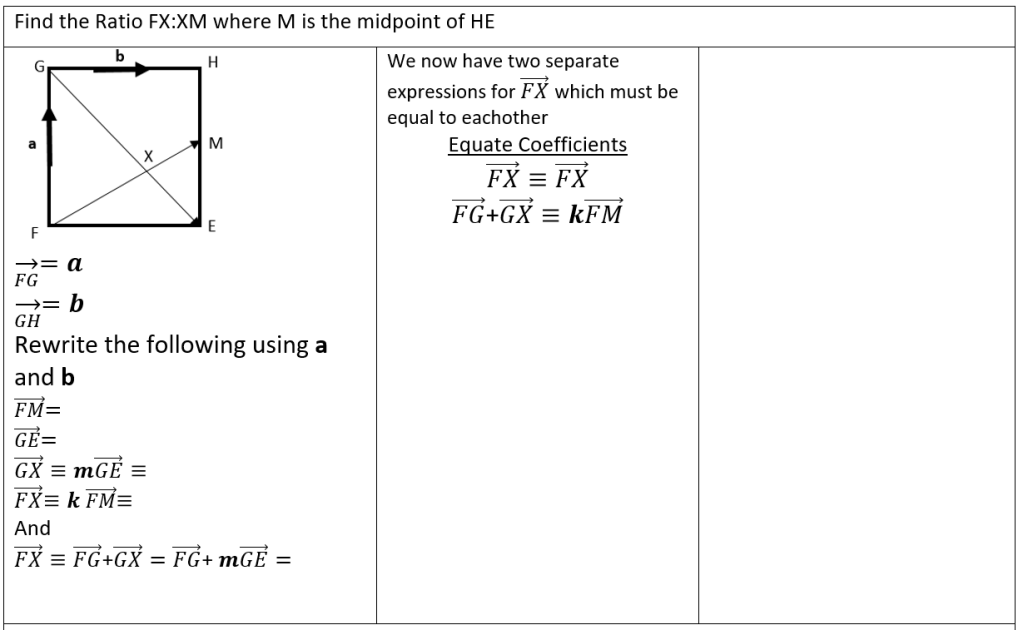
Working out that this problem was relevant to our initial question was such a wonderful aha moment for me. We were just playing around on some whiteboards wondering what the simplest form of the vectors question might look like – a classic problem solving technique that always brings me joy – when we settled on this. Although you can solve this with similar shapes as well as straight line graphs (I will leave those as an fun extension) the vector proof feels not only very elegant but also leads directly into its more harder variations. Below is how it was presented to the students after some discussion and attempts from them.

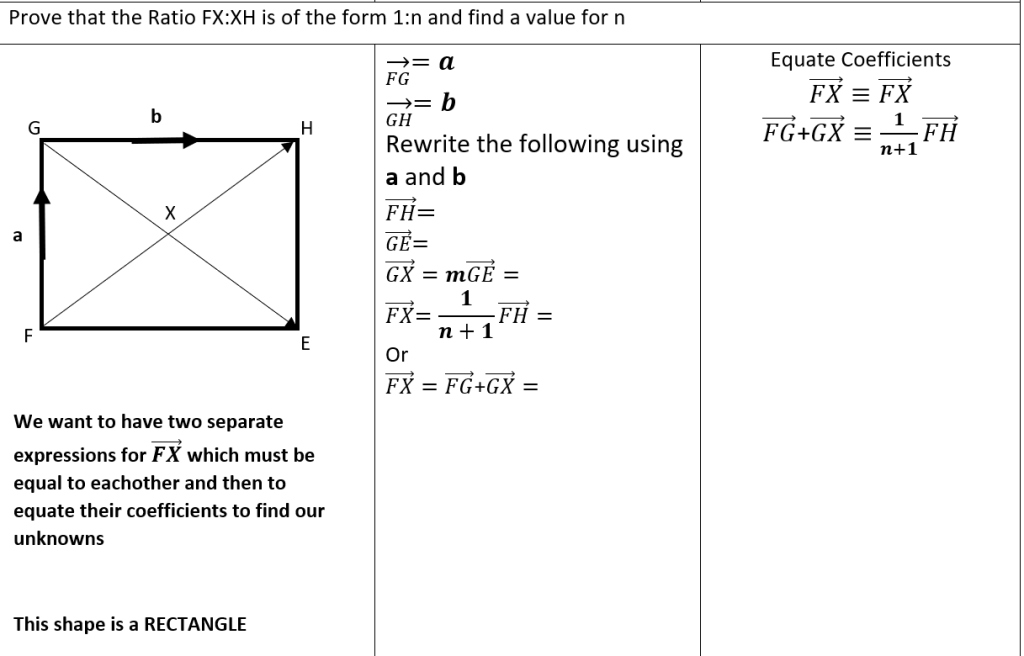
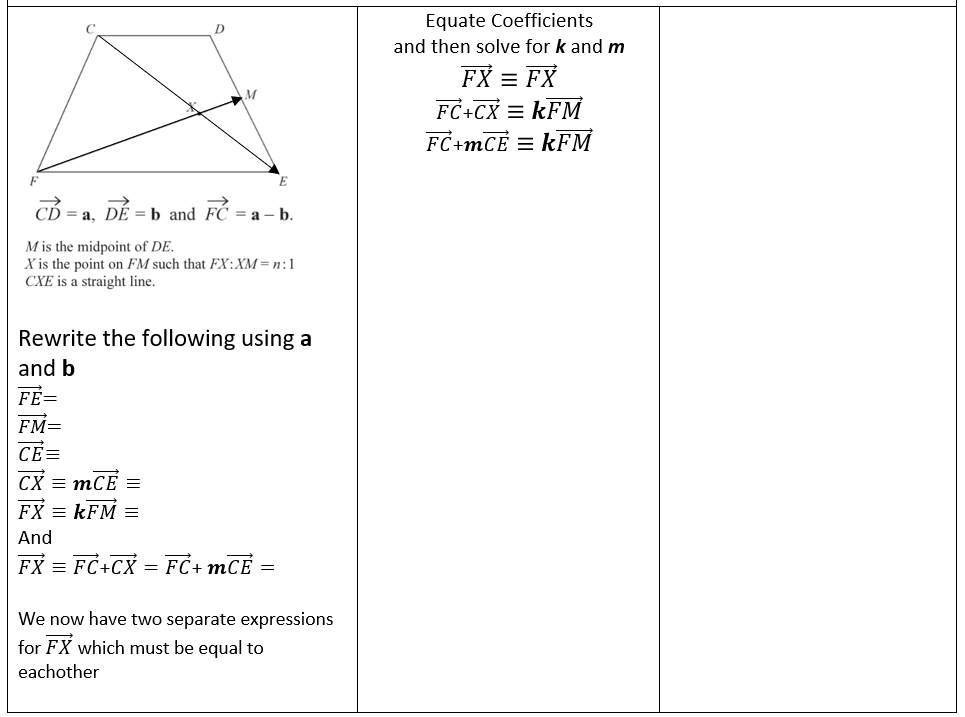
This is the beginning of the Slow Build Vectors worksheet that the students were given – made using the wonderful equation editor on Word

Once the students had attempted this question we worked through it together as a class making sure that there was a consensus of understanding they were then encouraged to work through the rest of the worksheet in pairs using the whiteboards around the room to play around with the questions.

Generalizing the previous problem to rectangles of any size

Eventually they had tackled a few simpler questions and they were faced with the same (albeit more structured) vectors question they had seen in their mock exam.

Adding in a twist before leading on to the main event

Part 4: The Main Event

The most brutal P1 mark I have ever seen

Seriously this was two marks or something. The students could have completely left this out and still done phenomenally well (as they did!) but the students have every right to want to understand everything that could possibly come up on their GCSEs and also maths is so cool and the JOURNEY. The JOURNEY. Such an absolutely joy. Big shout outs to the one student in the whole year group who got the marks as well as to some awesome colleagues for dealing with me pestering them about the question repeatedly over the course of a week.

Part 5: AOB

Whether a question like this will every actually come up again seems very doubtful, and whether my students would have thought to use these skills if it had come up is also doubtful but I think there is such a joy in deeply exploring one question and seeing all the other Maths that falls out.

Below are the links to the full worksheets – feel free to click, download and try them yourself!

If you are interested in seeing more Slow Build worksheets I am currently in the process of adding them to the Slow Build page on this website!

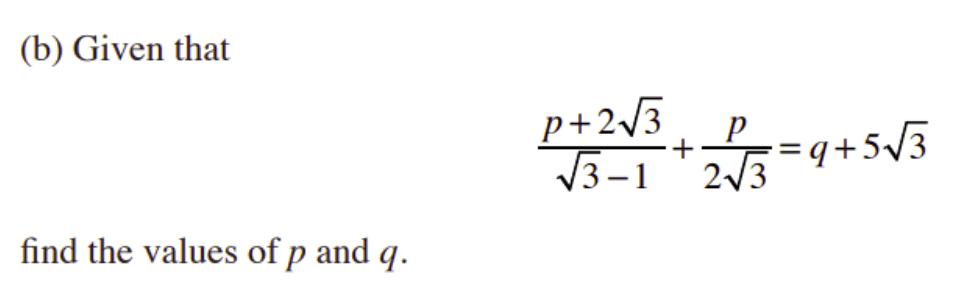
Bonus extension question sent to me by Woody L – show that p and q are both 6
Another bonus question that can be solved using equating (Show that c is 3 and d is 13)

NJK

Categories
Maths for Fun

Trigonometry Fun

During this Lockdown period the wonderful youtuber 3blue1brown has created a youtube series called “Lockdown Maths” that have been a glorious set of lectures. These are two worksheets I created that directly use puzzles that are mentioned in this lecture: https://www.youtube.com/watch?v=QvuQH4_05LI&t=1501s

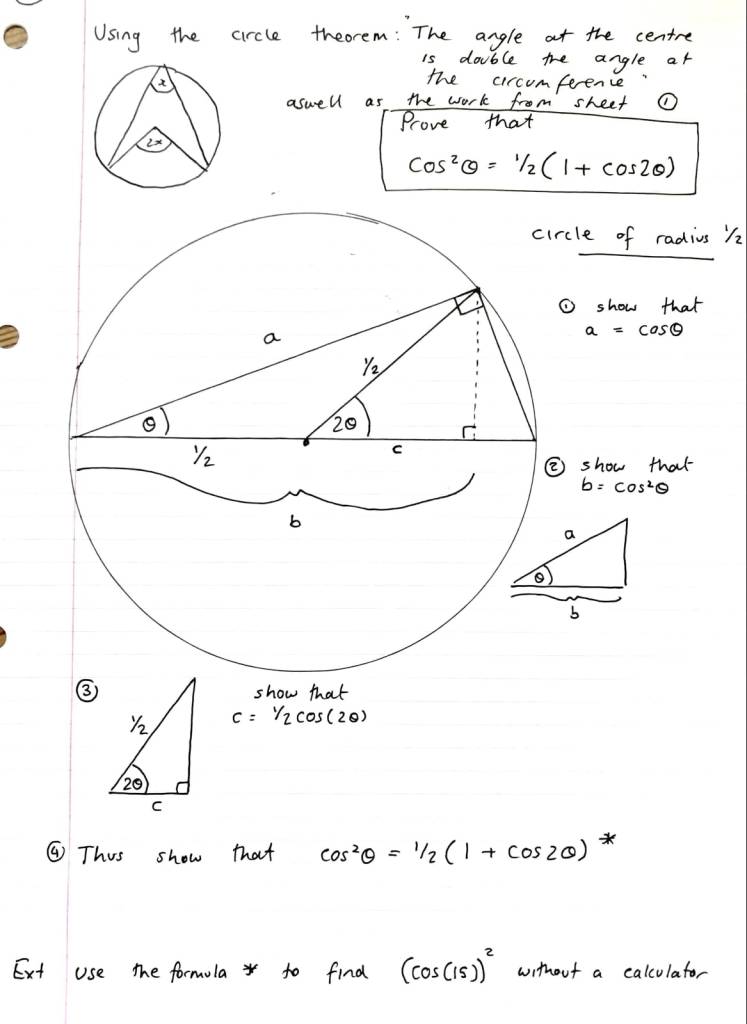
They are beautiful geometric proofs of some often (and less often) used Trigonometric Identities. The techniques used in the first sheet will help greatly in the second sheet and lead me to a fantastic aha moment.

For example in sheet 1 you end up proving pythagoras’ theorem from a trig identity – something that feels like the wrong way round!

Link to PDF for Trig Identity Sheet 1

Link to PDF for Trig Identity Sheet 2

NJK