Categories
Learning from Puzzles Maths for Teaching

Creating from UKMT

So many things happening in one question!

The wonder of the UKMT

I have said before on this blog that I absolutely adore the UK Maths Challenge as a way of massively improving your problem solving skills and using preexisting tools in totally new ways. It’s also an absolute goldmine for interesting purposeful practice. One of my favourite way of creating resources is by choosing a UKMT (UK Maths Trust) question that I particularly enjoy and seeing in what glorious directions it can lead.

From Question to Exercise: Square Root Puzzle

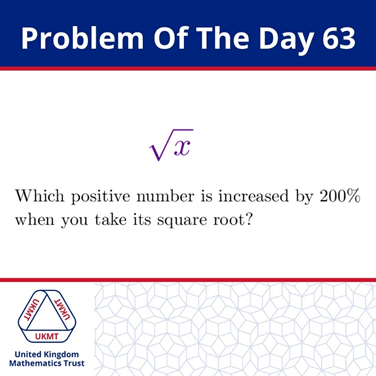
Lets look at the question above – what seems like a relatively simple question has a wonderfully elegant solution. I will include the answer at the bottom of the post – although as usual I would recommend trying the question first!

The start of the worksheet

So to start with students are encouraged to just try the question themselves – they have the whole page to write down their thoughts and try different things and if they want some support they can turn to the next page.
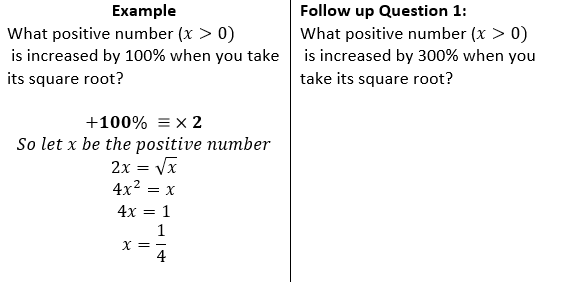
An example and follow up question to help with the UKMT question

They can work through the simpler example I have given them and then go on to doing very similar questions to the original so they can practice the steps involved. These slight variations mean that students can use what they have used in previous examples to help when the questions get slightly weirded!
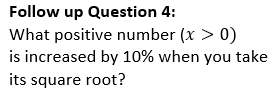
An interesting alternative question

The questions progress, using an differing increases before finally looking at a more general example!

The generalised example
But why?

Although the question feels pretty niche there is lots of maths to be practised here. The link between a percentage increase and the corresponding numerical multiplier, solving simple quadratic equations and some nice thoughts on fractions lead to an exercise that practises some key skills in a nice creative way! I plan on using it as some problem solving practice after having taught part of those topics.

Please feel free to try it by downloading here – The answers are available through the resources under the subheading “Problem Solving”

From Question to Exercise: Factors and Square Numbers

Another UKMT question with depth galore

How would you attempt the above question? You could just work out the multiplication and then square root that product to find out the missing value. But square rooting in notoriously a tricky function without a calculator and also where is the fun in that! It also will become an increasingly impractical method the larger the numbers get – for example in the question below…

Surely there is a nicer way of solving this!

Simplifying the question

The beginning of the worksheet

As with lots of the worksheets I make I like to start with simple questions for students to work through and throwing in an example to help but the aim is for it to be a relatively self-explanatory exercise that slowly builds to the intended questions that we want to solve!

These questions also came from a wonderful UKMT question that I saw and needs some knowledge about the structure of square numbers to answer it. In particular that the prime factors of square numbers have to come in even pairs. For example 16 can be represented as 4 x 4 but also as two pairs of 2 x 2. The number 18 on the other hand is built from 3 x 3 x 2 so you have a pair of 3s but then one factor left over so it is not a square number. How could we make 18 a square number just by looking at its factors? We need to find a buddy for that extra factor of 2 so by x 2 we end up with 3 x 3 x 2 x 2 = 36 which is a square number! You can even rearrange it slightly and write it as (3 x 2) x (3 x 2) to make it even clearer that it is a square number as it is something times itself.

Showing that this product gives us a square number using factors! Find a, b and c!

So for the question above you can rewrite 64 as 8 x 8 and 4 as 2 x 2 and by rearranging you then have (8 x 2) x (8 x 2) which means that 64 x 4 has to be 16 squared! A wonderfully simple way of solving these questions and also a great excuse to practise factorising (prime and not prime!)

Try these yourself!

You can try the worksheet yourself here and the answers can be found on our resources page. Its such a delightful little puzzle with a lovely solution – Even coming up with your own questions is fun so I implore you to try that too!

Post Credits

The UKMT is an absolute goldmine of maths and puzzles. Even more excitingly the UKMT has extended solutions to their maths challenges that include additional questions and investigations for each question so I would definitely suggest checking that out here

Below is the solution to the original problem:

As always thank you so much for reading and if you are interested in getting involved with us let us know here and you can also subscribe so you don’t miss out on any content by entering your email below!

NJK

Categories
Learning from Puzzles

Cracking the Cryptic: Joy and Magic Squares

A fun magic square problem that requires good knowledge of how they work – try it out!

Magic Squares

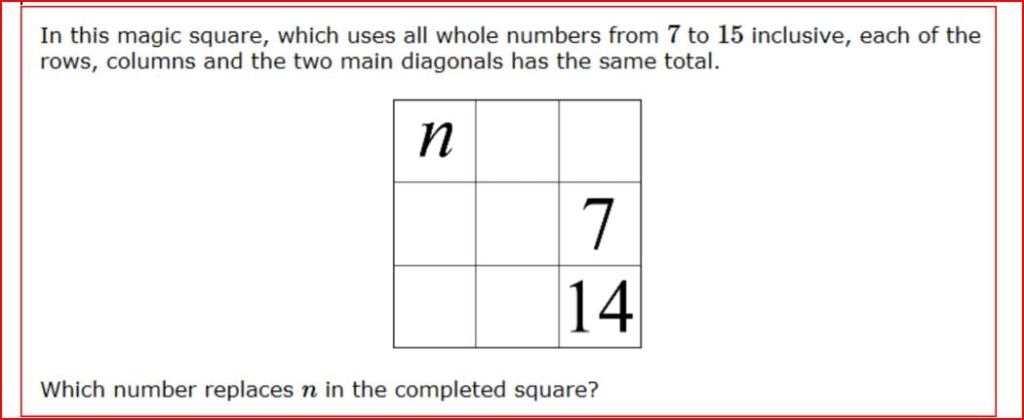
Magic squares always feel like a go-to end of term fun activity and one I have never given a particularly large amount of thought to – when I saw this question come up on a facebook maths page I am a member of I wasn’t sure how easy it would be but I talked it through in my head and came to a nice answer (I will go through the answer at the end of this post – Try it out yourself!) and I knew the reason I was able to solve this puzzle so easily was thanks to my new favourite YouTube channel: Cracking the Cryptic

Cracking the Cryptic

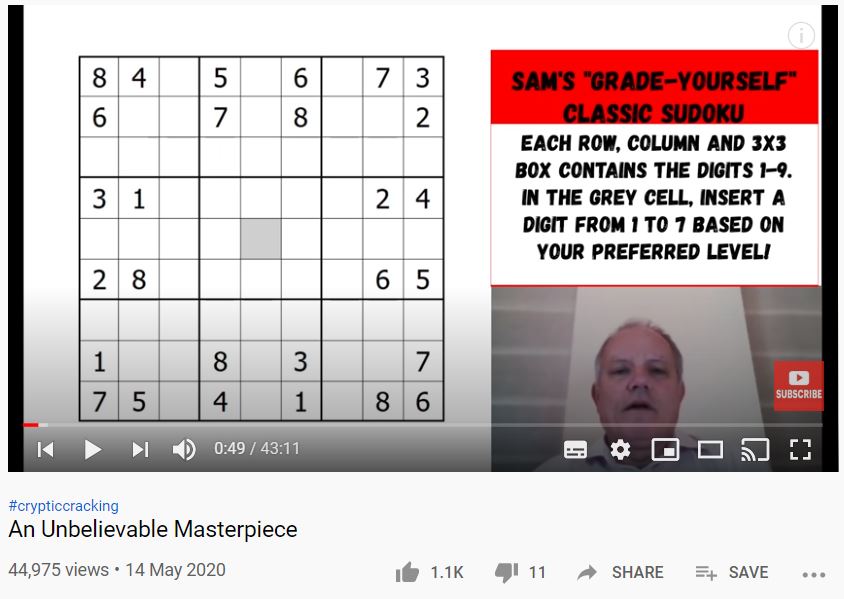
One of the glorious puzzles I have done during Lockdown

It’s hard to describe the pure joy that the YouTube channel crackingthecryptic has given me over the lockdown period. Glorious and regular puzzles that have honestly captivated me for hours on end. For a few weeks solving their latest puzzle over breakfast (and inevitably lunch because they were so tricky) became a minor addiction for me and lead me to many great Aha moments that my housemates soon tired of hearing about!

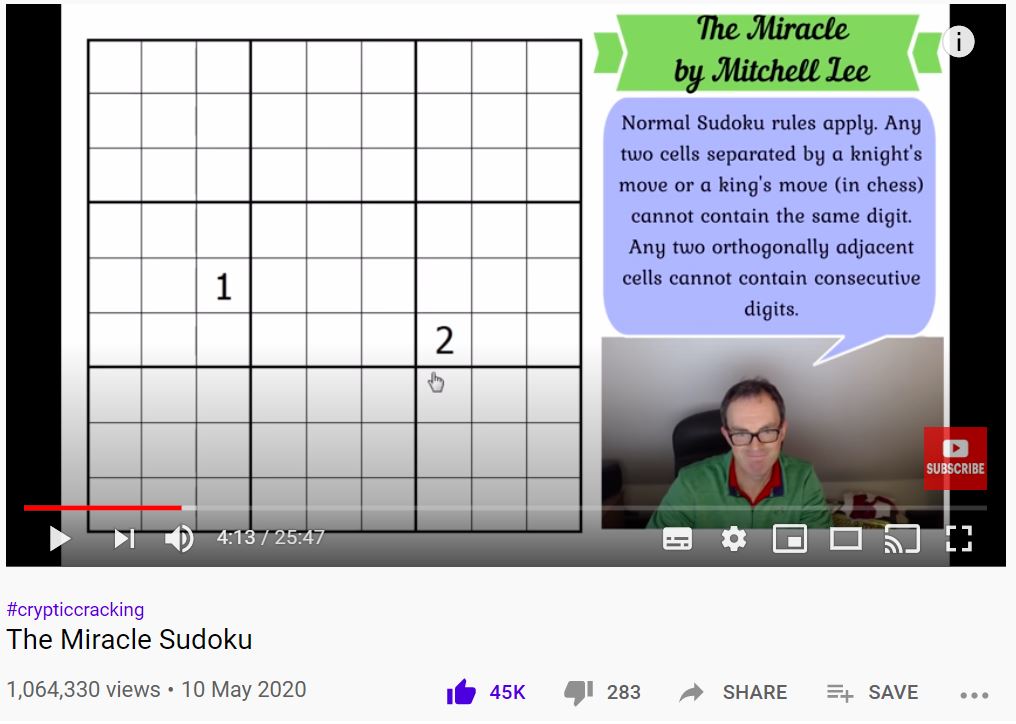
The above puzzle makes use of a simple 3 by 3 magic square in the middle of the grid that must contain all the digits 1-9 with all rows/columns/diagonals adding to the same amount. But how to even get started? As you know that all together the sum of the numbers 1-9 is 45 that means that each row/column/diagonal has to contain numbers that sum to 15 so that the three rows/columns add to the same amount and together add to 45. Then you can work out what number has to go in the middle an therefore is part of every single row/column/diagonal – the number ends up always being the median of the numbers you had to start with – so in this case it is 5 and that’s your starting point for the rest of the puzzle!

It was this previous knowledge that helped me to answer the question at the top of this post so quickly – because I had seen similar problems in different contexts I was able to use those problem solving skill to quickly find the number that should go in the middle square and then the rest of the problem solves itself from there. The more maths/puzzles you play around with the better you will be in the future!

Some of my favourite CtC puzzles

Below are screenshots and links to some of the bests puzzles I have attempted and sometimes even completed. I urge you to try them yourselves and let us know what you thought.

The most incredible puzzle solving hour of my life finishing this puzzle – click the picture to try it! It has OVER A MILLION VIEWS

Post Credits

The more puzzles and problems you grapple with the better you will be at grappling. Also it’s shocking how rarely I actually sit down and concentrate on something for an hour at a time without distractions and these Cracking the Cryptic puzzles gave me many of those hours.

How to solve: You know that as the whole grid must contain the numbers 7-15 the total of everything within the grid must be 99. As there are three rows/columns we divide by 3 to get 33 and therefore each r/c/d must equal 33 so the top left box must be 33-14-7=12

We also know that the number in the middle is the median number from 7-15 so must be 11 and then we fill in the rest of the grid from there! “n” must be 33-11-14 so n = 8

Let us know if you try and of the puzzles by clicking here – Thanks for reading!

NJK

Categories
Learning from Puzzles

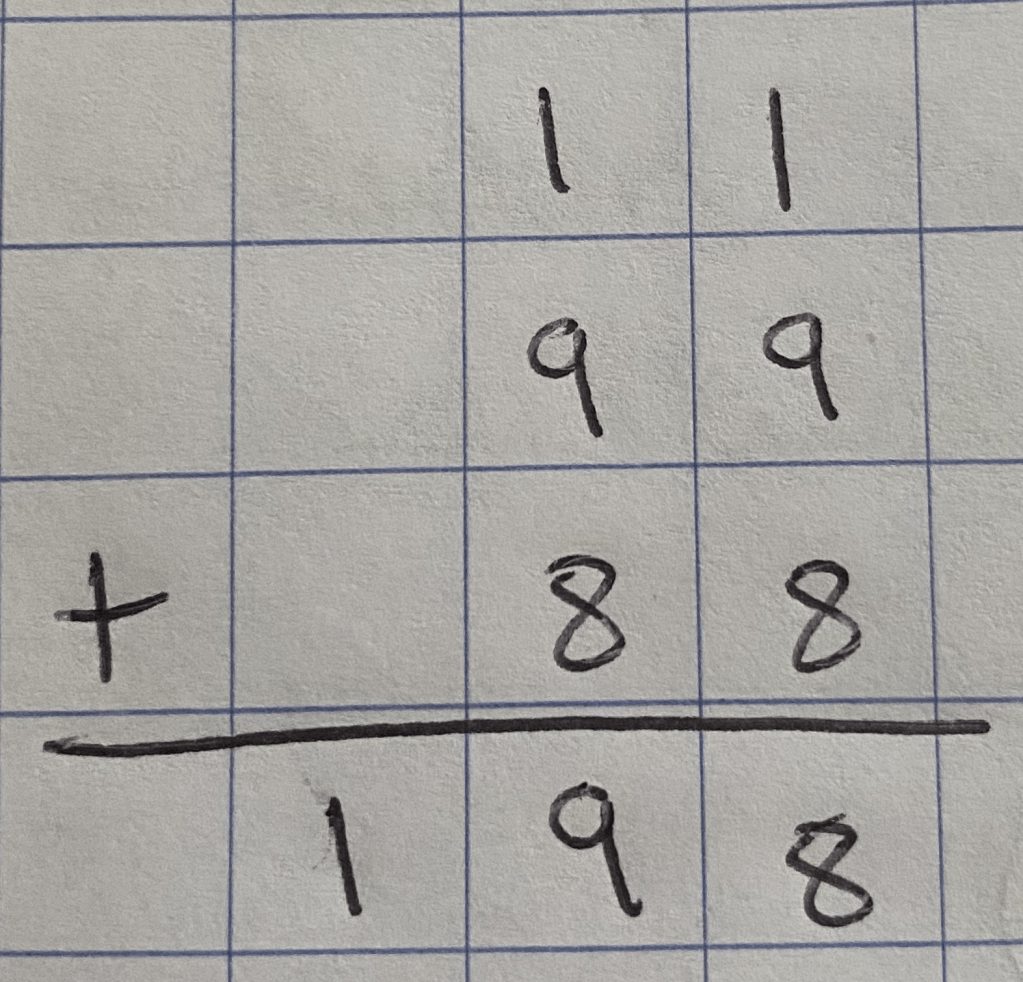
A Digit Problem

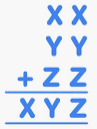
I was recently given this problem by a colleague and it immediately took my interest. As soon as I saw it my first thoughts were not “what is the answer?” but “is there an answer? Is there more than one answer? Can I prove this?”.

I spent that lunchtime in my classroom looking at the problem. I started by looking at the digits in the units column and noticed that since the value of the units in the answer must be z then x + y = multiple of 10. This gave me different possibilities to consider:

  • x + y = 0. Since x or y can not be negative (they are digits) then the only other possibility is if x = y = 0 and using quick inspection this clearly does not work.
  • x + y = 10. This is feasible since there are multiple ways 2 single digits can sum to 10.
  • x + y = 10n, where n is any integer greater than 1. This is not possible since x and y are single digit numbers so can not sum to any number greater than 18.

This was the first breakthrough in the problem as I now had an equation that places a constraint on the possible values of x and y.

I then adopted a similar approach with the tens column (x + y = 10 so don’t forget to “carry” the 10 into the tens column which I initially did!). Looking at the digits we can see that 10x + 10z + 10 = 100x which we can simplify to get z + 1 = 9x. Now since x, y and z are all single digit numbers I could then use the two constraints to deduce their values:

x + y = 10 (A)

z + 1 = 9x (B)

  • Looking at equation (B) x = 1 and z = 8 since x, y and z are single digit numbers
  • Substituting x = 1 into equation (A) we can see that y = 9

So I had obtained “the answer” and could see that it works. It’s always satisfying to find the answer to a maths problem but it’s even more satisfying to say with confidence that this is the only answer and prove it with reason. I presented this problem to a high ability year 8 class with no instructions and was intrigued to see how their thinking was to trial numbers and simply search for “the answer”. As expected, many of them were able to find the correct values for x, y and z but weren’t able to tell me with any conviction if these are the only possible answers.

I am sure there are other proofs to this relatively straightforward problem and I would be interested to see people’s suggestions!

DTH