Categories
Learning from Puzzles Maths for Teaching

Creating from UKMT

So many things happening in one question!

The wonder of the UKMT

I have said before on this blog that I absolutely adore the UK Maths Challenge as a way of massively improving your problem solving skills and using preexisting tools in totally new ways. It’s also an absolute goldmine for interesting purposeful practice. One of my favourite way of creating resources is by choosing a UKMT (UK Maths Trust) question that I particularly enjoy and seeing in what glorious directions it can lead.

From Question to Exercise: Square Root Puzzle

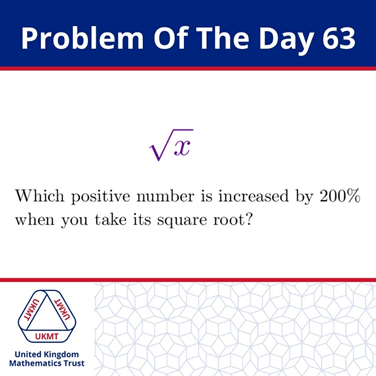
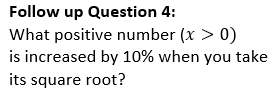
Lets look at the question above – what seems like a relatively simple question has a wonderfully elegant solution. I will include the answer at the bottom of the post – although as usual I would recommend trying the question first!

The start of the worksheet

So to start with students are encouraged to just try the question themselves – they have the whole page to write down their thoughts and try different things and if they want some support they can turn to the next page.
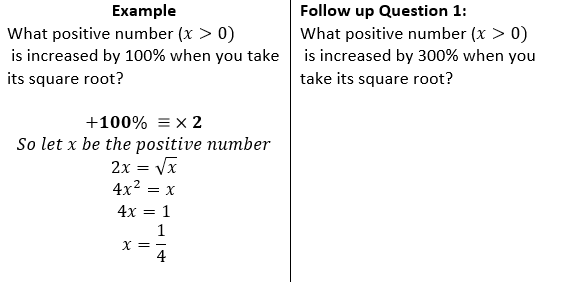
An example and follow up question to help with the UKMT question

They can work through the simpler example I have given them and then go on to doing very similar questions to the original so they can practice the steps involved. These slight variations mean that students can use what they have used in previous examples to help when the questions get slightly weirded!
An interesting alternative question

The questions progress, using an differing increases before finally looking at a more general example!

The generalised example
But why?

Although the question feels pretty niche there is lots of maths to be practised here. The link between a percentage increase and the corresponding numerical multiplier, solving simple quadratic equations and some nice thoughts on fractions lead to an exercise that practises some key skills in a nice creative way! I plan on using it as some problem solving practice after having taught part of those topics.

Please feel free to try it by downloading here – The answers are available through the resources under the subheading “Problem Solving”

From Question to Exercise: Factors and Square Numbers

Another UKMT question with depth galore

How would you attempt the above question? You could just work out the multiplication and then square root that product to find out the missing value. But square rooting in notoriously a tricky function without a calculator and also where is the fun in that! It also will become an increasingly impractical method the larger the numbers get – for example in the question below…

Surely there is a nicer way of solving this!

Simplifying the question

The beginning of the worksheet

As with lots of the worksheets I make I like to start with simple questions for students to work through and throwing in an example to help but the aim is for it to be a relatively self-explanatory exercise that slowly builds to the intended questions that we want to solve!

These questions also came from a wonderful UKMT question that I saw and needs some knowledge about the structure of square numbers to answer it. In particular that the prime factors of square numbers have to come in even pairs. For example 16 can be represented as 4 x 4 but also as two pairs of 2 x 2. The number 18 on the other hand is built from 3 x 3 x 2 so you have a pair of 3s but then one factor left over so it is not a square number. How could we make 18 a square number just by looking at its factors? We need to find a buddy for that extra factor of 2 so by x 2 we end up with 3 x 3 x 2 x 2 = 36 which is a square number! You can even rearrange it slightly and write it as (3 x 2) x (3 x 2) to make it even clearer that it is a square number as it is something times itself.

Showing that this product gives us a square number using factors! Find a, b and c!

So for the question above you can rewrite 64 as 8 x 8 and 4 as 2 x 2 and by rearranging you then have (8 x 2) x (8 x 2) which means that 64 x 4 has to be 16 squared! A wonderfully simple way of solving these questions and also a great excuse to practise factorising (prime and not prime!)

Try these yourself!

You can try the worksheet yourself here and the answers can be found on our resources page. Its such a delightful little puzzle with a lovely solution – Even coming up with your own questions is fun so I implore you to try that too!

Post Credits

The UKMT is an absolute goldmine of maths and puzzles. Even more excitingly the UKMT has extended solutions to their maths challenges that include additional questions and investigations for each question so I would definitely suggest checking that out here

Below is the solution to the original problem:

As always thank you so much for reading and if you are interested in getting involved with us let us know here and you can also subscribe so you don’t miss out on any content by entering your email below!

NJK

Categories
Learning from Puzzles Maths for Teaching

Quadratics on Quadratics

Stacks of Quadratics

Problem from the brilliant mindyourdecisions youtube channel

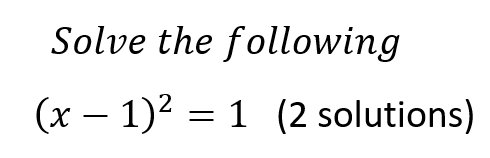
Firstly I would urge you to try the question in the photo yourself. It requires some knowledge of powers and solving quadratics and is wonderfully satisfying to find all SIX solutions.

Looking at easier examples

Questions like this are a great example of finding creative ways to practice fundamental skills. In this case one of the key skills being practised here is the ability to solve quadratic equations and rearranging them into a form that you can solve easily. So how to introduce this to a class?

A possible starting place

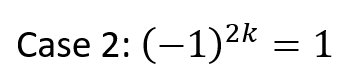
Lets look at the example in the picture – How can we can get to a solution of 1 on the LHS of our equation? The two cases that make this happen: Case 1 by setting (x-1) = 1 and case 2 by setting (x-1) = -1

Both these methods when squared will give us our answer of 1 and so that is where we will get our final values of x to be 2 and 0.

Taking it a step further

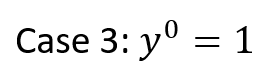
So taking it a step further we now an expression as our power which gives us a third case: Setting x+2 to zero. When the power is zero whatever is inside the bracket is irrelevant as any real numbers to the power of zero equal to 1.

Okay 1 to the power of anything is one so x-1 = 1 gives us our first solution: x=2

In case two we need -1 to an even power to get to one so we have x-1 = -1 which gives us a solution of x=0 which when put into the power gives us an even power so it must be a solution

Finally in case 3 we set x+2 = 0 which gives us our third solution and final solution which is x=-2 and it is solved! Now can we use this simpler example to work our way up to the six solutions of the first problem?

Creative Practice

Small worksheet building up to answering stacked quadratic questions

I used the sheet above as a starter in my first lesson with my new year 11s – as a little bit of a fun way to gauge both their ability and their desire to apply maths they definitely know in ways they might not have seen before. The questions don’t lead onto each other as nicely as I might like but once we had discussed the first few the whole class were able to get their teeth into the rest of them.

By working through this small exercise they were able to practise factorising and solving quadratics in a way that felt fresh and interesting whilst also giving me an opportunity to circulate and learn more about my class.

Post Credits

I will not explain the full explanation for the question as it seems only fair to direct you to the original video here for a lovely detailed work through of the solution. Once you have watched the video try the rest of the worksheet!

I encourage you to try each of the questions looking at each of the three cases. Then try and come up with some of your own that fit this format – I always think one of the best ways to improve is to play around with writing your own questions and these are a fun way to start!

If you want to download the worksheet as a word document click here

Answers can be found on our Resources page

Thanks for reading!

NJK

Categories
Learning from Puzzles Maths for Fun

Asking for a fence

Farmers’ Area Problems

I recently came across this fencing problem posed by two mathematically minded farmers, the first part of which I feel is rather well known. Questions such as these are easy to visualise, meaning you can often give an instinctive answer and then test if your intuition was correct after solving the problem.

Part 1: The Warm Up

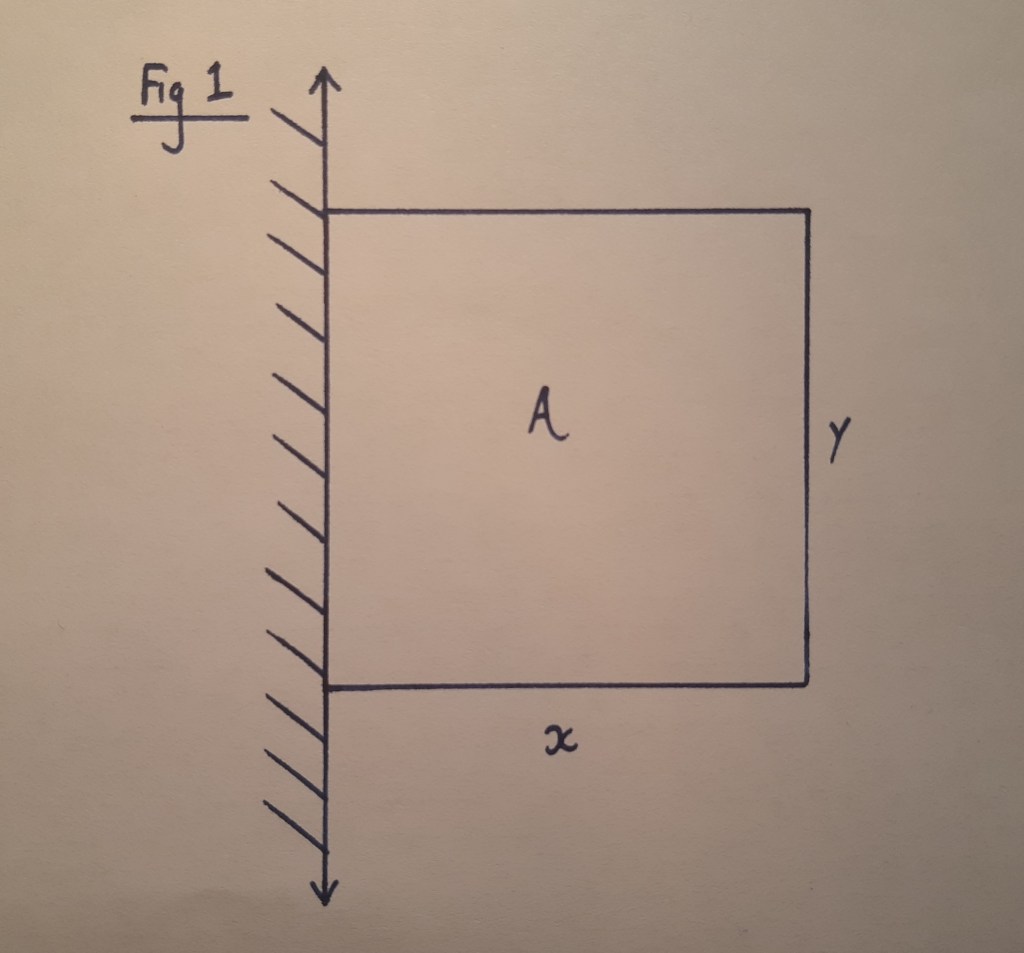
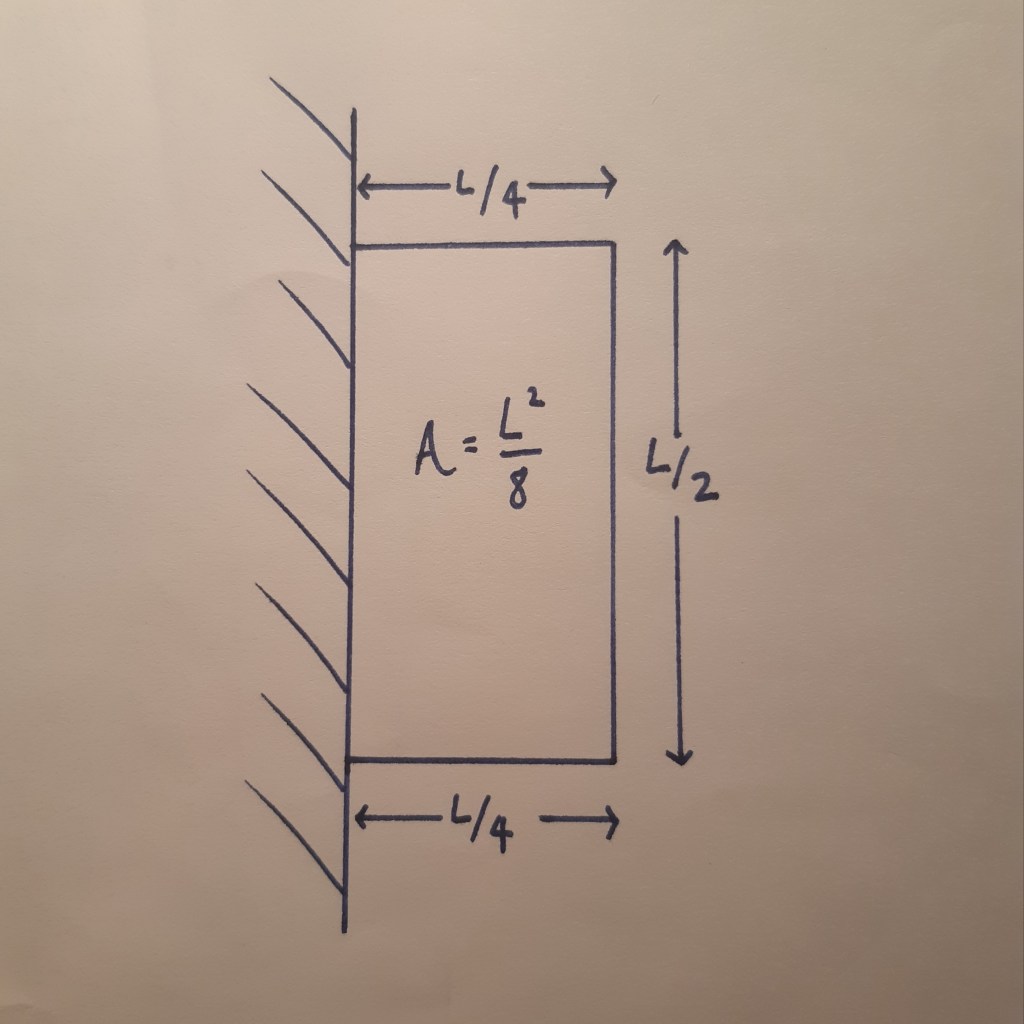
Consider an established farmer who has a very long (infinitely, if need be) straight fence forming part of the boundary of a field. Generously they have allowed you to use this fence, while constructing your neighbouring plot of land. Therefore we plan to enclose a rectangular field, only needing to build 3 sides of the quadrilateral. We will stipulate that the maximum length of these 3 sides is a length of L. The neighbours fence is shown below, on the left vertical.

Question: Using a fence of total length L, what ratio of sides will give the maximum area?

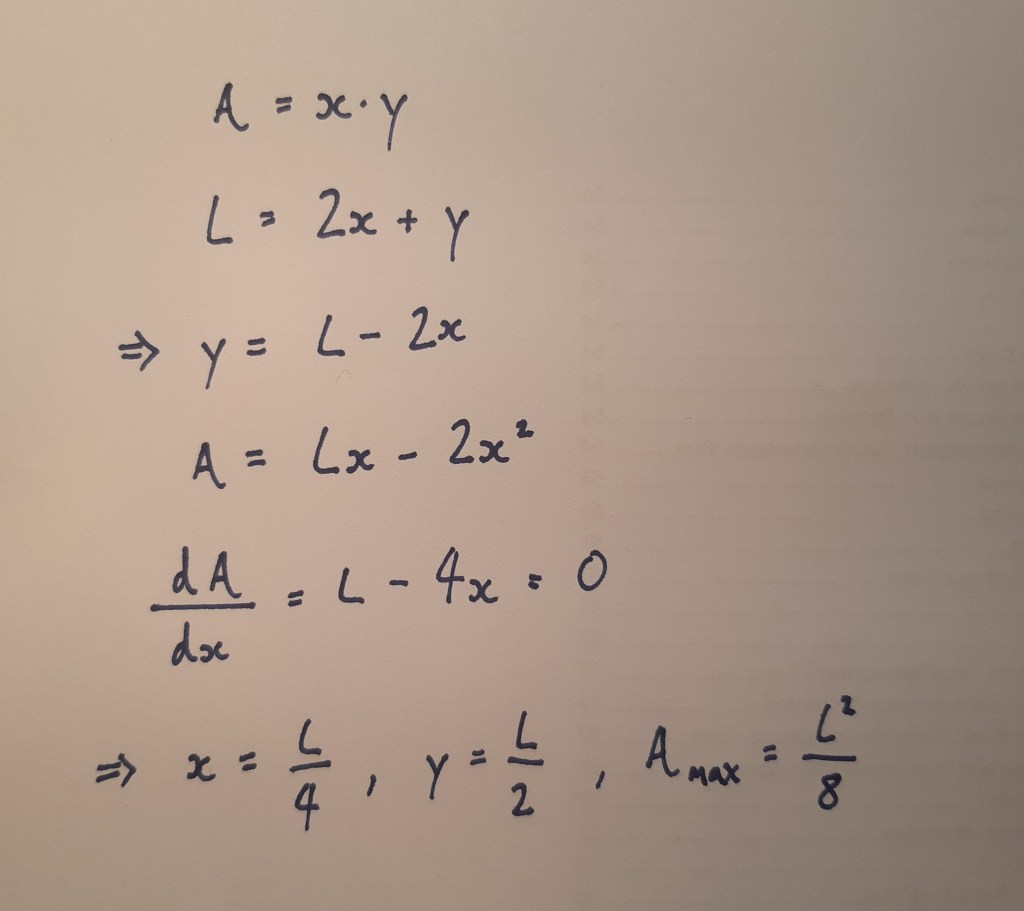
The idea here is to use the constraint on the fence length L to create an equation using our unknown side lengths, x and y. We can then use this to create a formula for the Area, using the constant L and one unknown.

With this formula in place, the problem then becomes a question of maximising the equation, which we can achieve by finding the stationary point of the derivative.

I’ve solved this below, so don’t scroll down if you would like to try this yourself!

The solution

I’ve also created a Desmos Graph to see how the area changes with different values of L.

So the answer is a 2:1 ratio in the direction of the neighbours fence. While this may not have been your initial intuition, it follows that adding to the fence in the vertical direction only costs half as much as adding in the horizontal direction, due to the free fence offered by our neighbour. Therefore, the maximal area will be achieved by having a vertical length double that of the horizontal length.

The fences that solve the puzzle

We will leave how our generous neighbour tends to their field of infinite size to another day.

Part 2: The Main Event

Considering the success of the first project, we have decided to expand our farm by building a new fence for a new field. This time the plot of land is somewhat different. 

In this case we have a square farm building in the middle of another very large field. We’ve realised that if we include the edge of the building as part of the fence, we can increase the area we enclose. 

One option is to align the field with the edge of the farm building (shown on the left below). However, our established neighbour has suggested we might want to consider using the long diagonal of the building as part of the fence. These two scenarios are shown below for the vertical and diagonal configurations building.

Question: Again considering a total fence length L and a square building of length l in both scenarios, which configuration gives the maximum area?

Again the solution to these two configurations follows a very similar pattern to the warm up question above. However, instead of working out the ratio of the side lengths, we need to find the maximal area of each scenario.

In the interest of time, we will solve these in parallel as the solutions are very similar. Additionally, there is a neat trick that we can use to minimise the effort required. In opening two statements, we can observe that both equations have equal coefficients of x and y. Therefore, we can interchange x and y freely in the formulas (since they are variables we have made up to understand the problem). This means any solutions we find for x, is automatically valid for y and is called a symmetric argument.

Now all that remains is to determine which of the two areas in the final row are larger. If we assume that the vertical configuration yields a larger area than the diagonal configuration, we can create an inequality to simplify in terms of L and l.

So we have found that the relative lengths of the fence and the side of the building impact what choice we should make. If the fence is much shorter than the side of the building, then we should choose the vertical configuration. Of course, we can reverse the inequality to find the alternate scenario.

Again, I’ve created an interactive Desmos Graph that gives a visual interpretation of the problem.

With the two solutions in place, we can now compare against our original instincts to check if we were correct. If you were, well done! If, like me, you were not, I find it useful to examine to think about why my intuition failed in order to improve for next time!

And finally, as the old saying goes, the enemy of my enemy is my fence.

SED